Jingtong Yan

Illustrator · Book Artist · Learning Designer

  • Works
  • Illustrations
  • Books & Prints
    • My Senses Garden
    • The Glasses Hunt
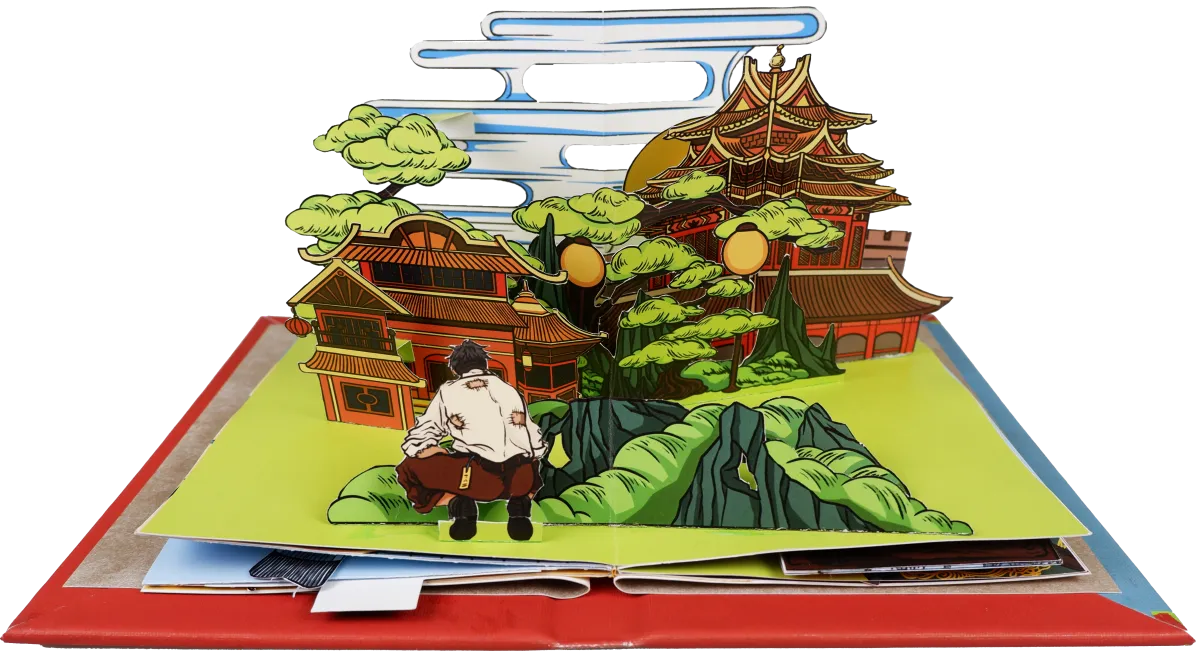
    • Folding Beijing
    • Pics in Aquarium
    • Drive Back to Summer
    • House
    • Giraffe Scanner
    • Fake Playbill
  • Motions
  • Learning Design
  • About Me

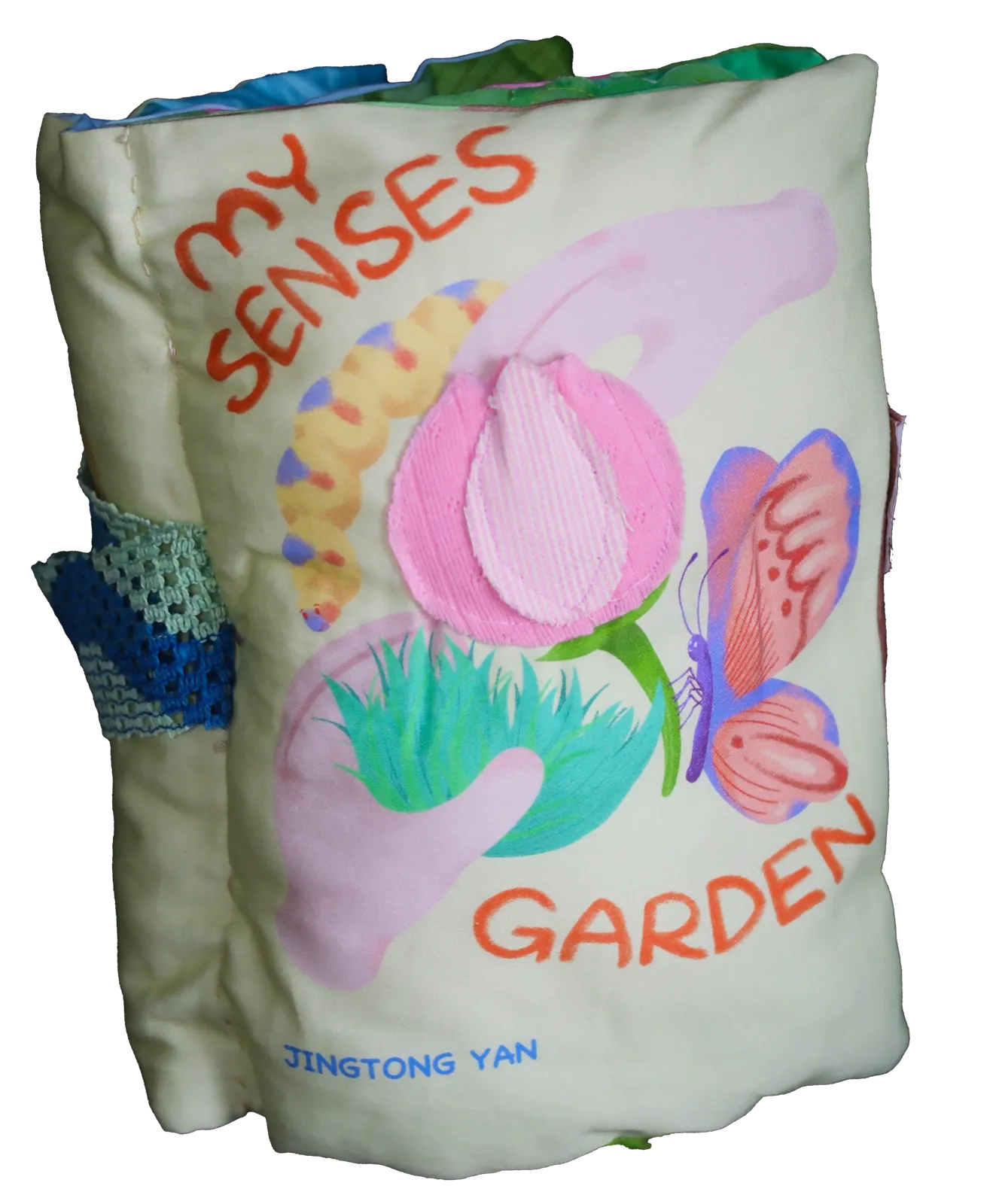
My Senses Garden

2025

My Senses Garden

  • Multisensory
  • Play-Based Learning
  • Interactive Book
  • Inclusive
  • Experiential
  • Embodied

2025

An interactive sensory book that invites readers to explore a "garden" through touch, sound, smell, taste, and sight — turning reading into a shared, hands-on experience.

  • Multisensory
  • Play-Based Learning
  • Interactive Book
  • Inclusive
  • Experiential
  • Embodied
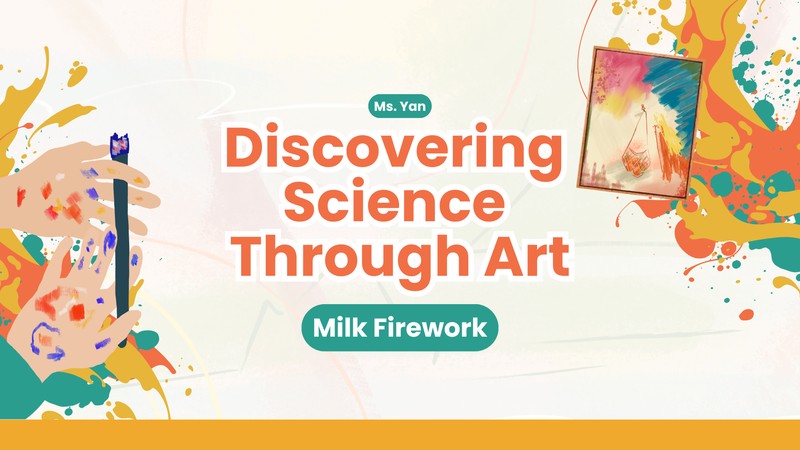
Discovering Science Through Art

2025

Discovering Science Through Art

  • STEAM
  • Curriculum Design
  • After-School Program
  • K–5
  • Inquiry-Based
  • Workshop Design

2025

A 9-week after-school STEAM curriculum that uses hands-on art-making to teach science concepts like surface tension, density, and chemical reactions.

  • STEAM
  • Curriculum Design
  • After-School Program
  • K–5
  • Inquiry-Based
  • Workshop Design
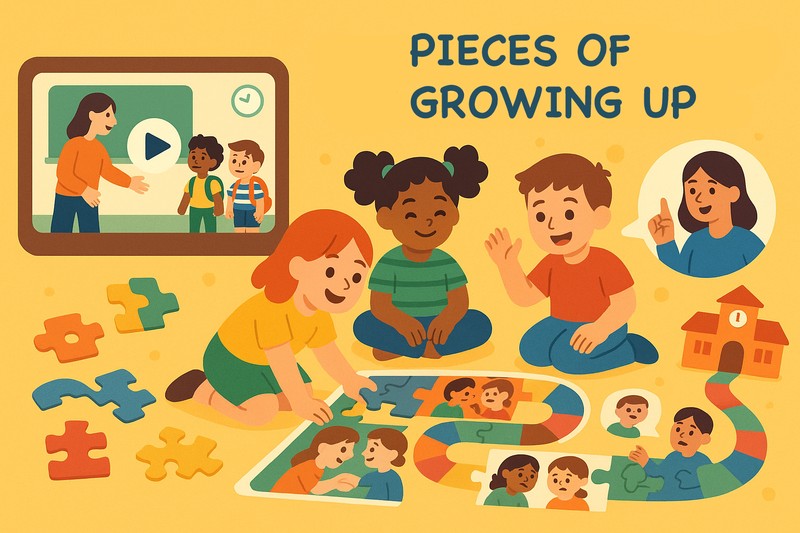
Pieces of Growing Up

2025

Pieces of Growing Up

  • SEL
  • Inclusive
  • Game-Based Learning
  • K–1 Transition
  • User Research
  • Collaborative

2025

A classroom-based SEL experience that uses short videos and puzzle decision-making to help Chinese first graders navigate the transition from kindergarten to elementary school.

  • SEL
  • Inclusive
  • Game-Based Learning
  • K–1 Transition
  • User Research
  • Collaborative
Community Mural Project

2025

Community Mural Project

  • Collaborative
  • Public Art
  • Youth Voice
  • Hands-On
  • Facilitation
  • Community

2025

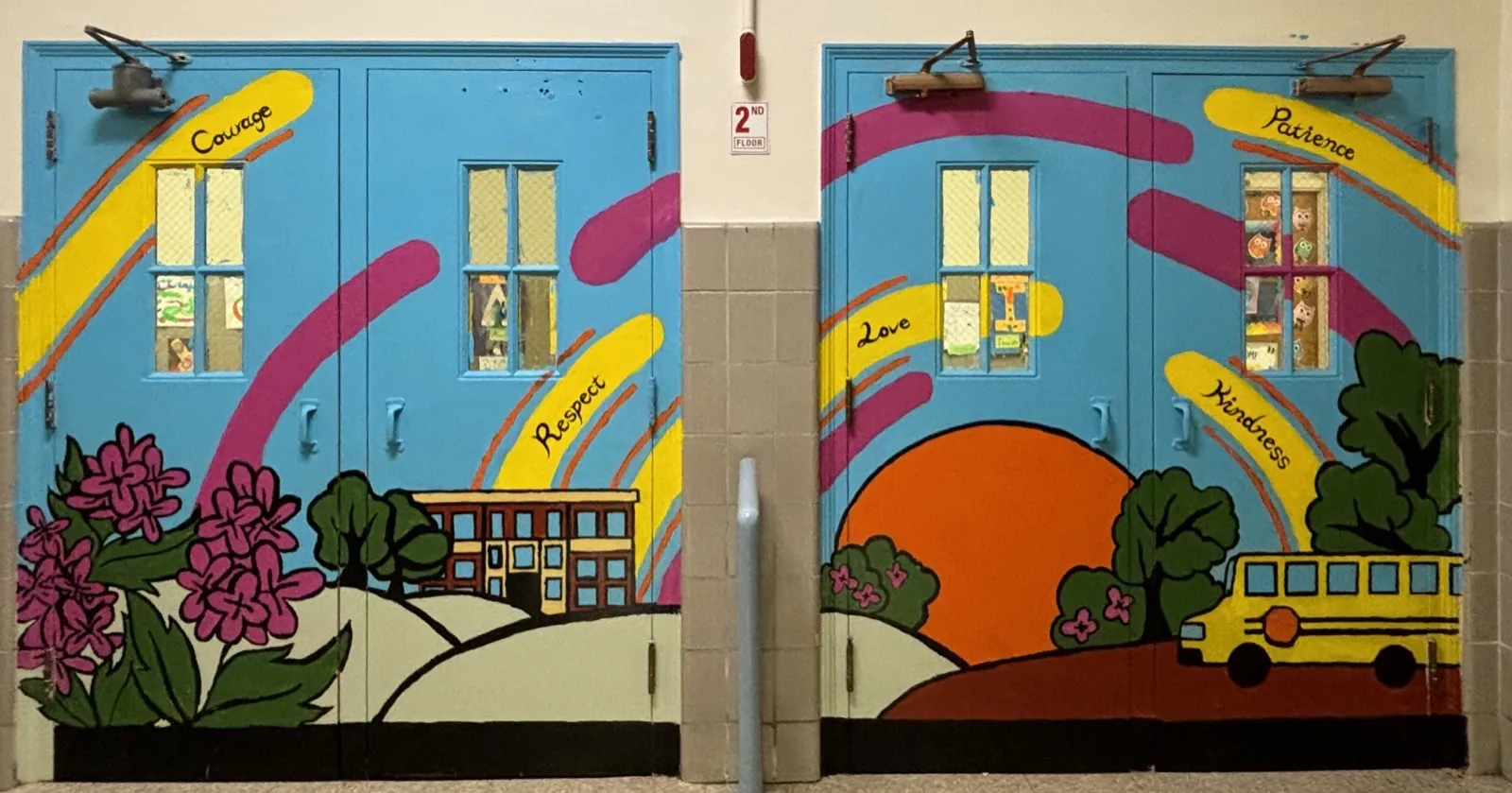
A collaborative mural project with 4th- and 5th-grade students, transforming four stairway doors into a continuous public artwork celebrating school values.

  • Collaborative
  • Public Art
  • Youth Voice
  • Hands-On
  • Facilitation
  • Community
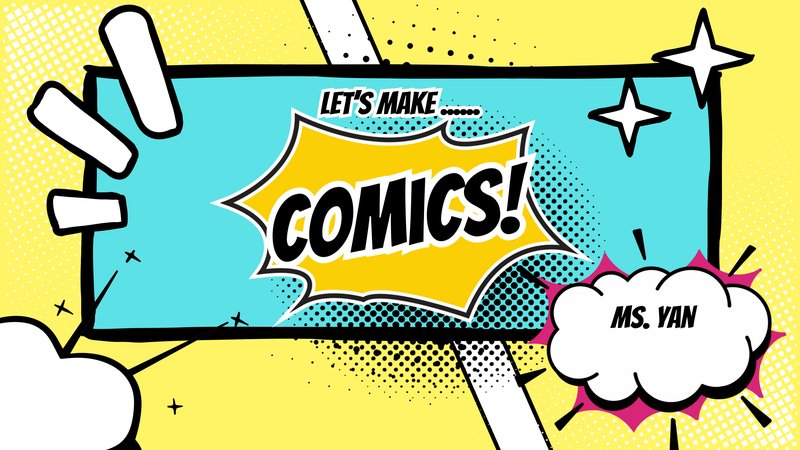
Let's Make Comics

2025

Let’s Make Comics

  • Scaffolded Learning
  • Collaborative
  • Workshop Design
  • Hands-On
  • Sequential Art
  • Youth Voice

2025

A 10-session comic-making workshop that progressively builds skills from panel layouts to a finished comic through character design, scripting, inking, and collaborative comic jams.

  • Scaffolded Learning
  • Collaborative
  • Workshop Design
  • Hands-On
  • Sequential Art
  • Youth Voice
The Glasses Hunt

2024

The Glasses Hunt

  • Intergenerational
  • Interactive Book
  • Story Play
  • Dual-Audience Design
  • Paper Engineering
  • Play-Based Learning

2024

An interactive pop-up book that serves two generations: children explore through play mechanics, grandparents learn through bonus zines.

  • Intergenerational
  • Interactive Book
  • Story Play
  • Dual-Audience Design
  • Paper Engineering
  • Play-Based Learning

2024

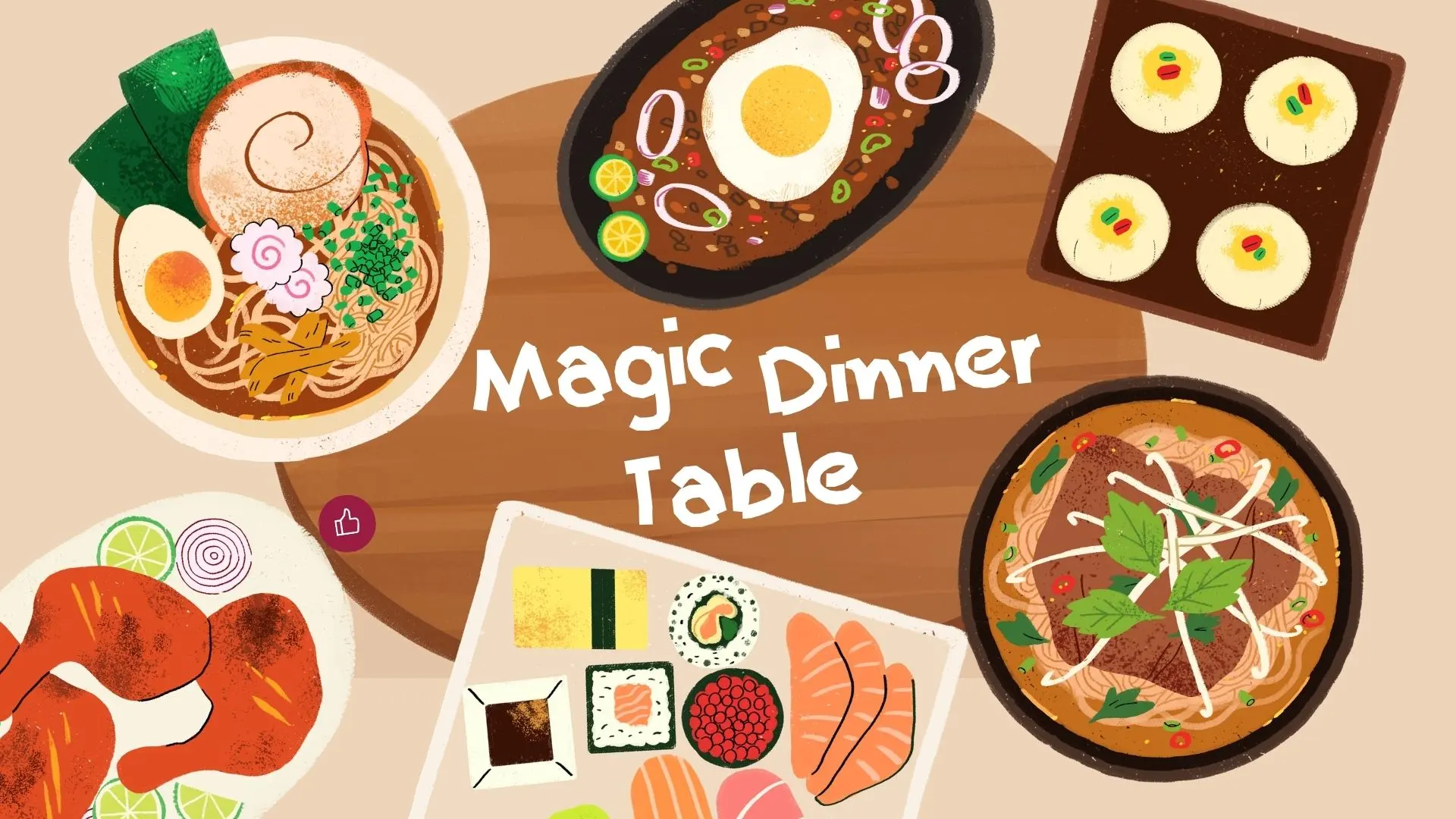
Magic Dinner Table

  • Identity
  • Culturally Responsive
  • Workshop Design
  • Studio Critique
  • Hands-On
  • Competition Prep

2024

A studio-based drawing project that helped middle-school students transform a competition prompt about dinner into personal visual narratives rooted in family memory, food traditions, and cultural identity.

  • Identity
  • Culturally Responsive
  • Workshop Design
  • Studio Critique
  • Hands-On
  • Competition Prep

2023

Our Future NYC

  • Culturally Responsive
  • Youth Voice
  • Collaborative
  • Hands-On
  • Identity
  • Workshop Design

2023

A collaborative summer banner project where middle school students imagined a future New York City through the cultures, landmarks, sports, and community values that mattered to them.

  • Culturally Responsive
  • Youth Voice
  • Collaborative
  • Hands-On
  • Identity
  • Workshop Design
Choose Your Weekend

2026

In Progress

Choose Your Weekend

  • Family Learning
  • Decision Making
  • Prototype
  • Planning
  • Adaptive Thinking
  • Mobile Experience

2026

In Progress

A design-in-progress mobile learning experience that helps children co-plan family weekends through constraints, backup thinking, preparation, and reflection.
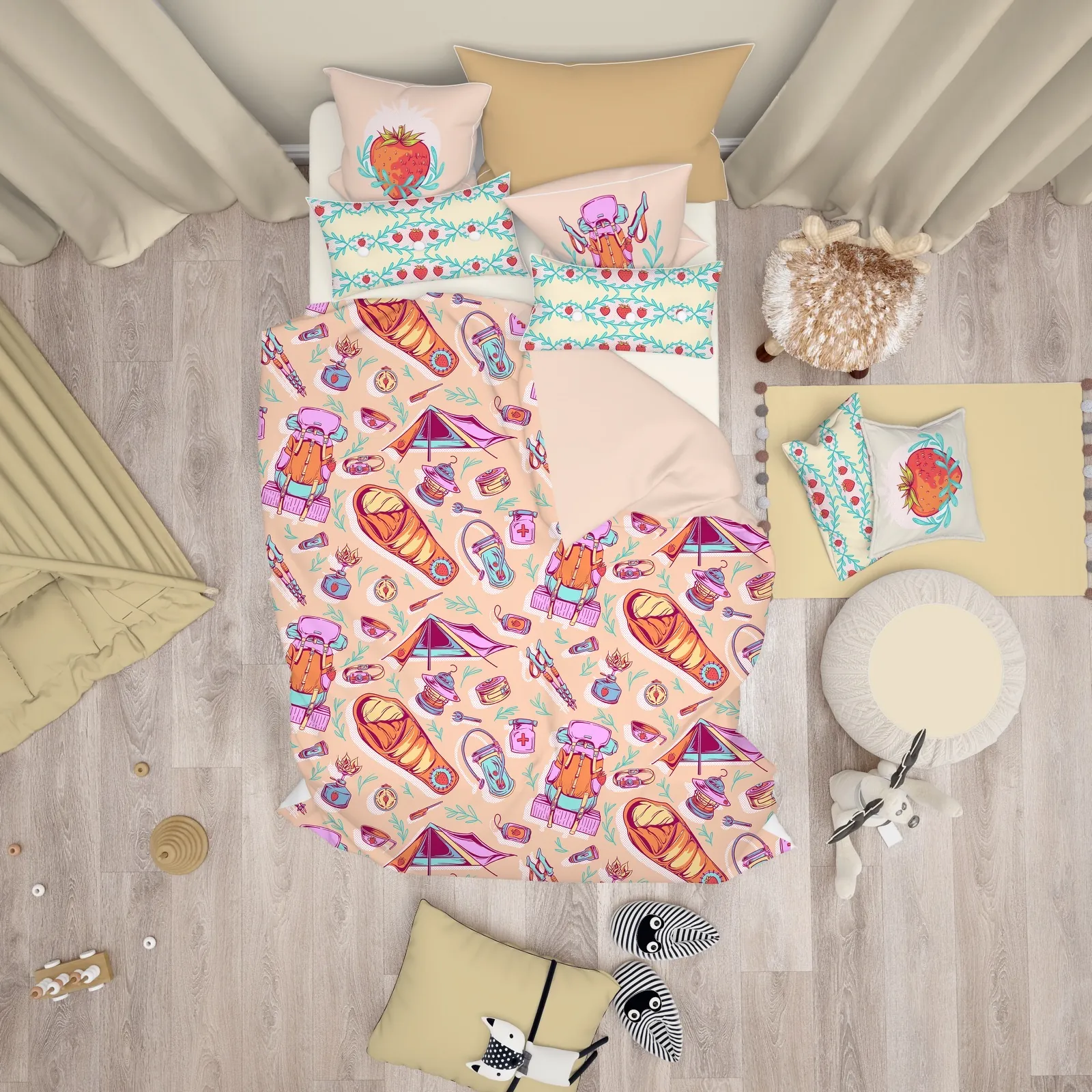
  • Family Learning
  • Decision Making
  • Prototype
  • Planning
  • Adaptive Thinking
  • Mobile Experience
Learning in Museum

2026

Coming Soon

Learning in Museum

  • Museum Learning
  • Interpretation
  • Visitor Experience

2026

Coming Soon

A museum learning framework focused on pacing, interpretation, and audience-friendly ways of encountering objects and stories.

  • Museum Learning
  • Interpretation
  • Visitor Experience
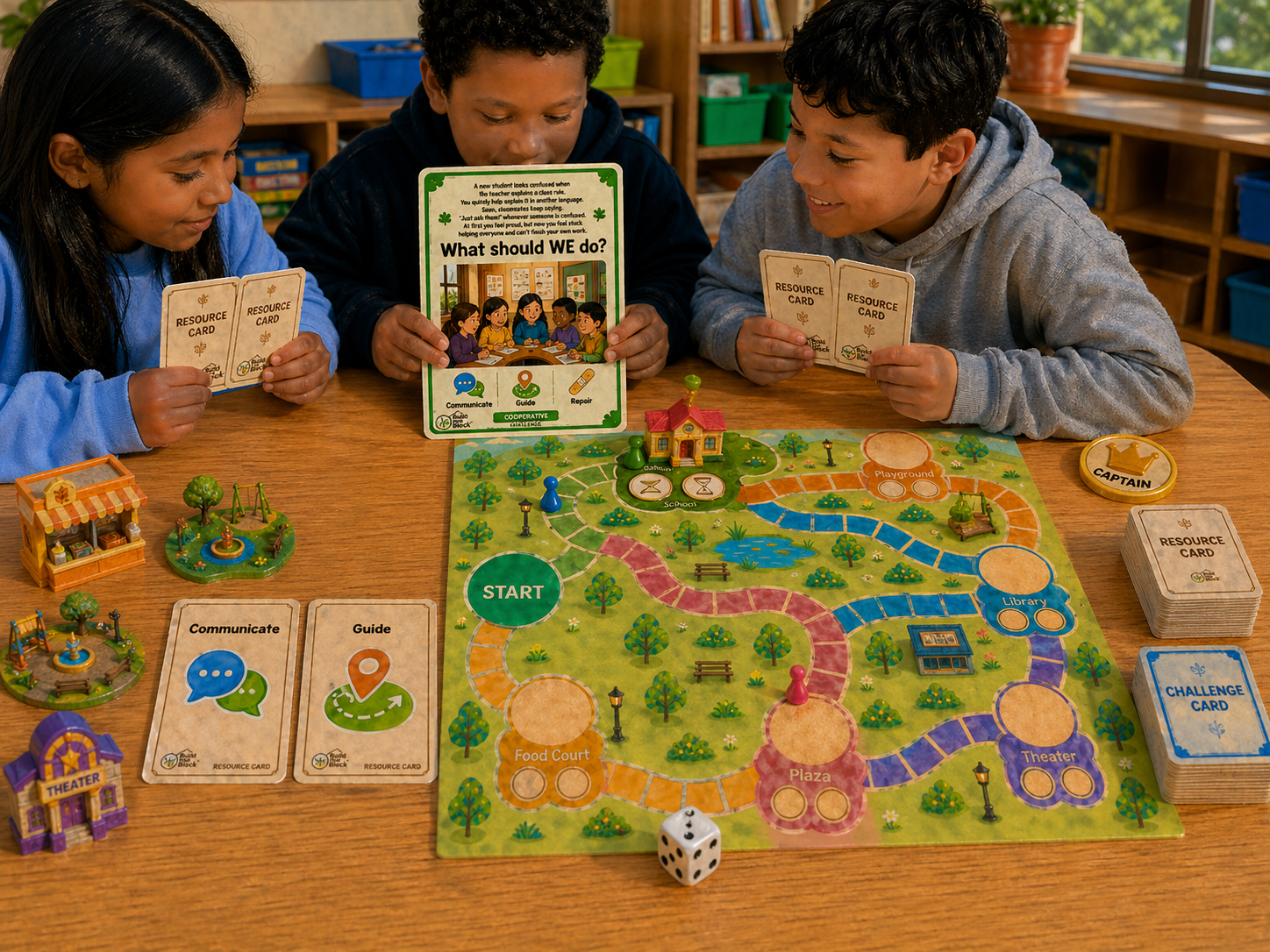
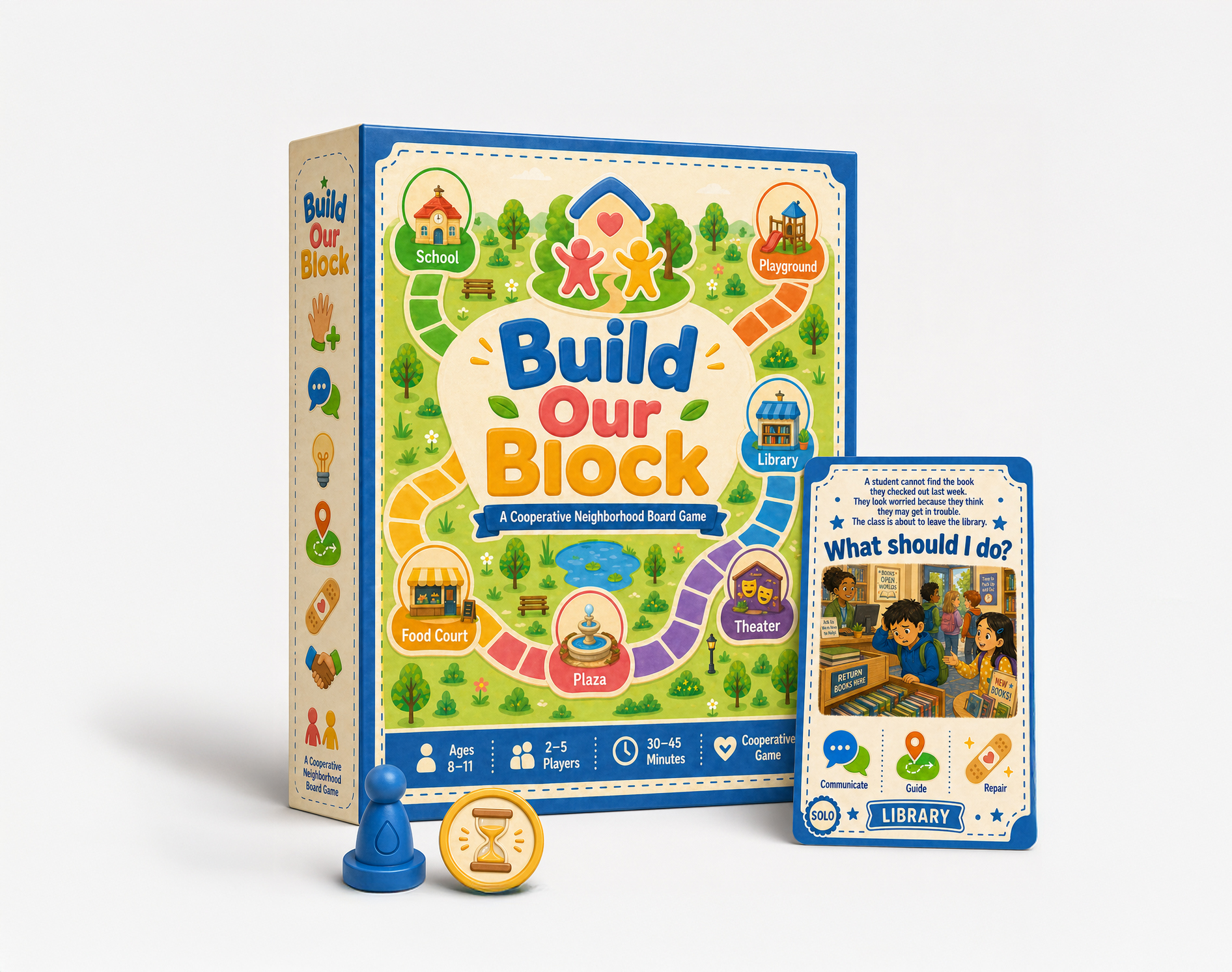
Build Our Block

2026

Coming Soon

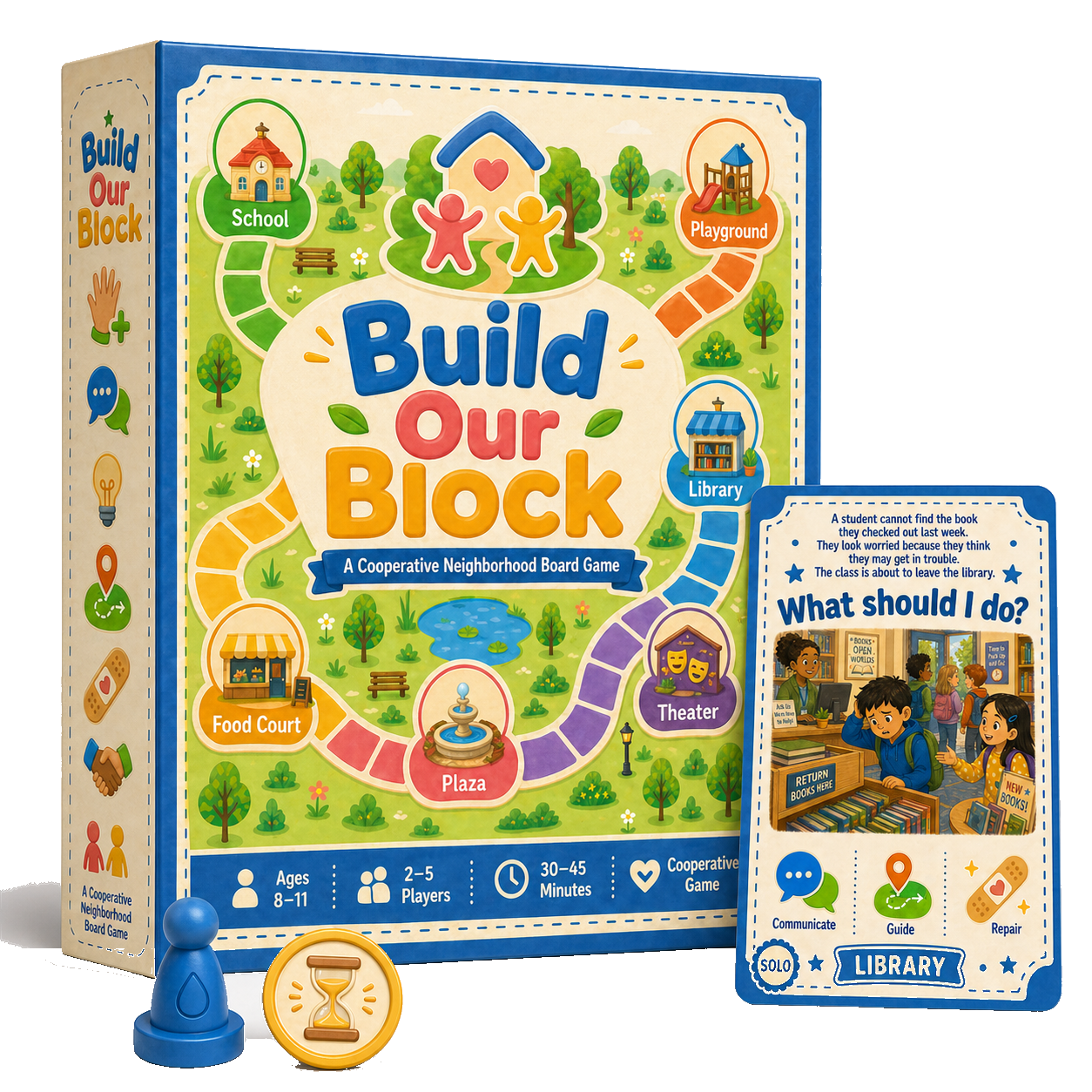
Build Our Block

  • Community Design
  • Urban Play
  • Collaborative Making

2026

Coming Soon

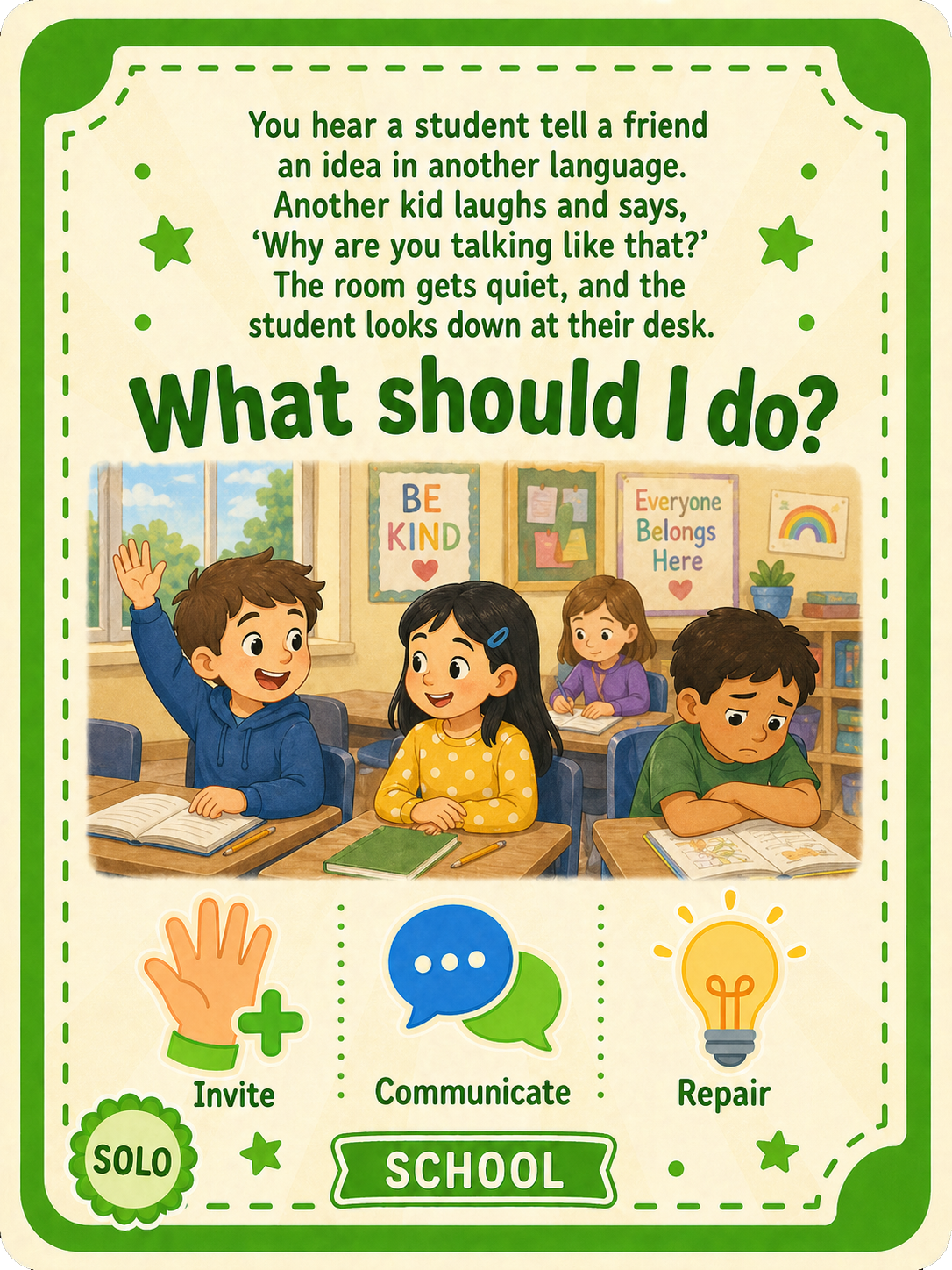
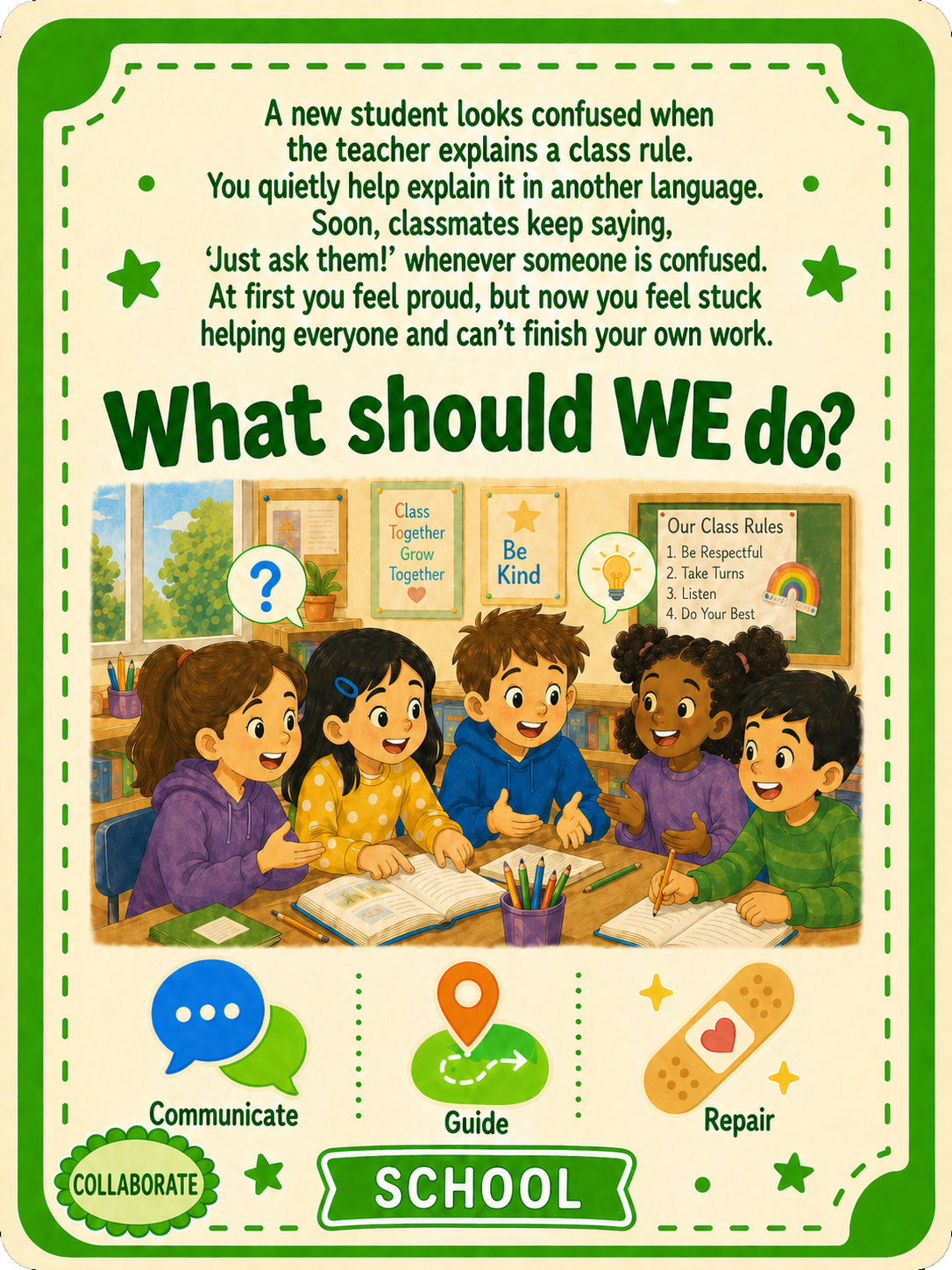
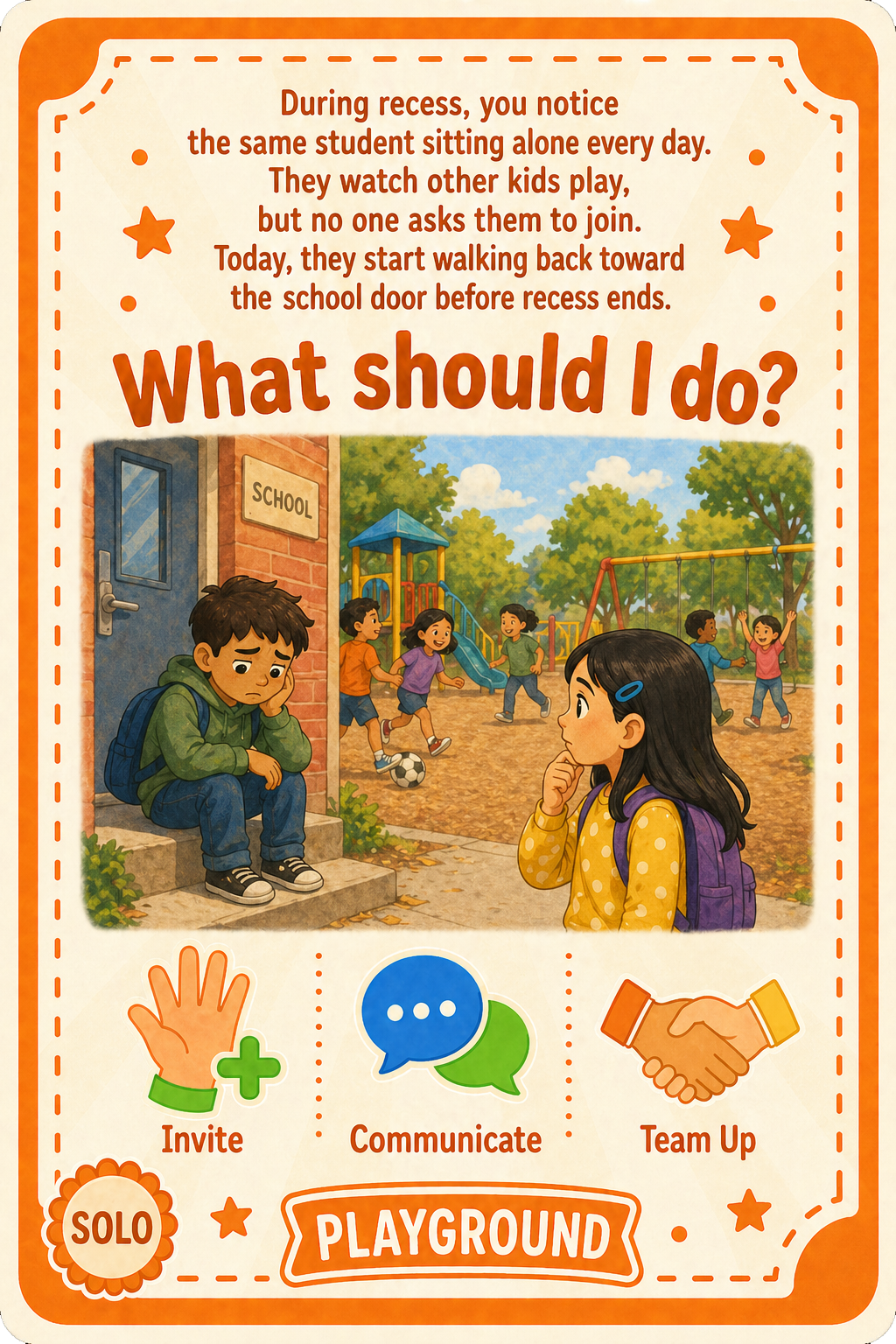
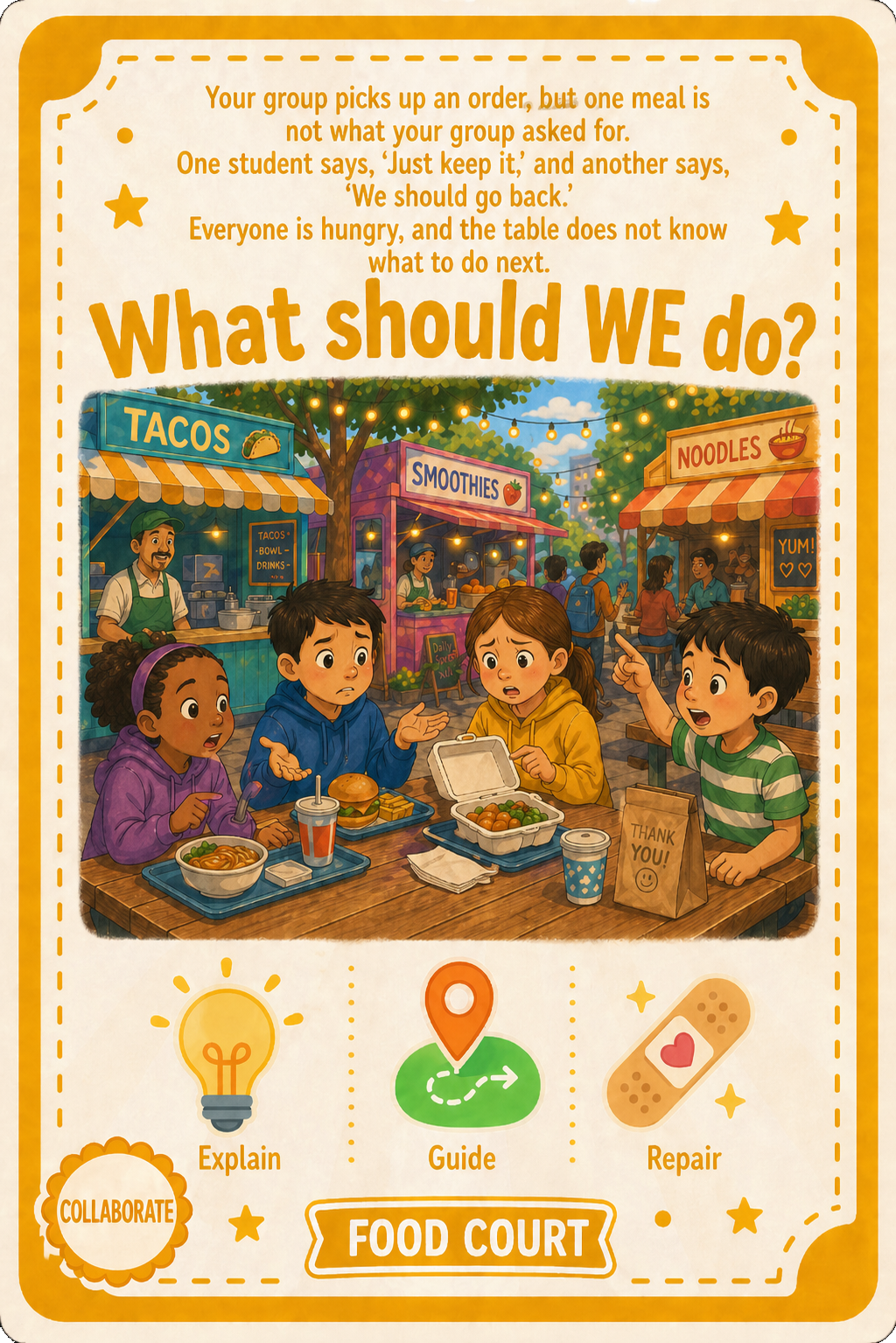
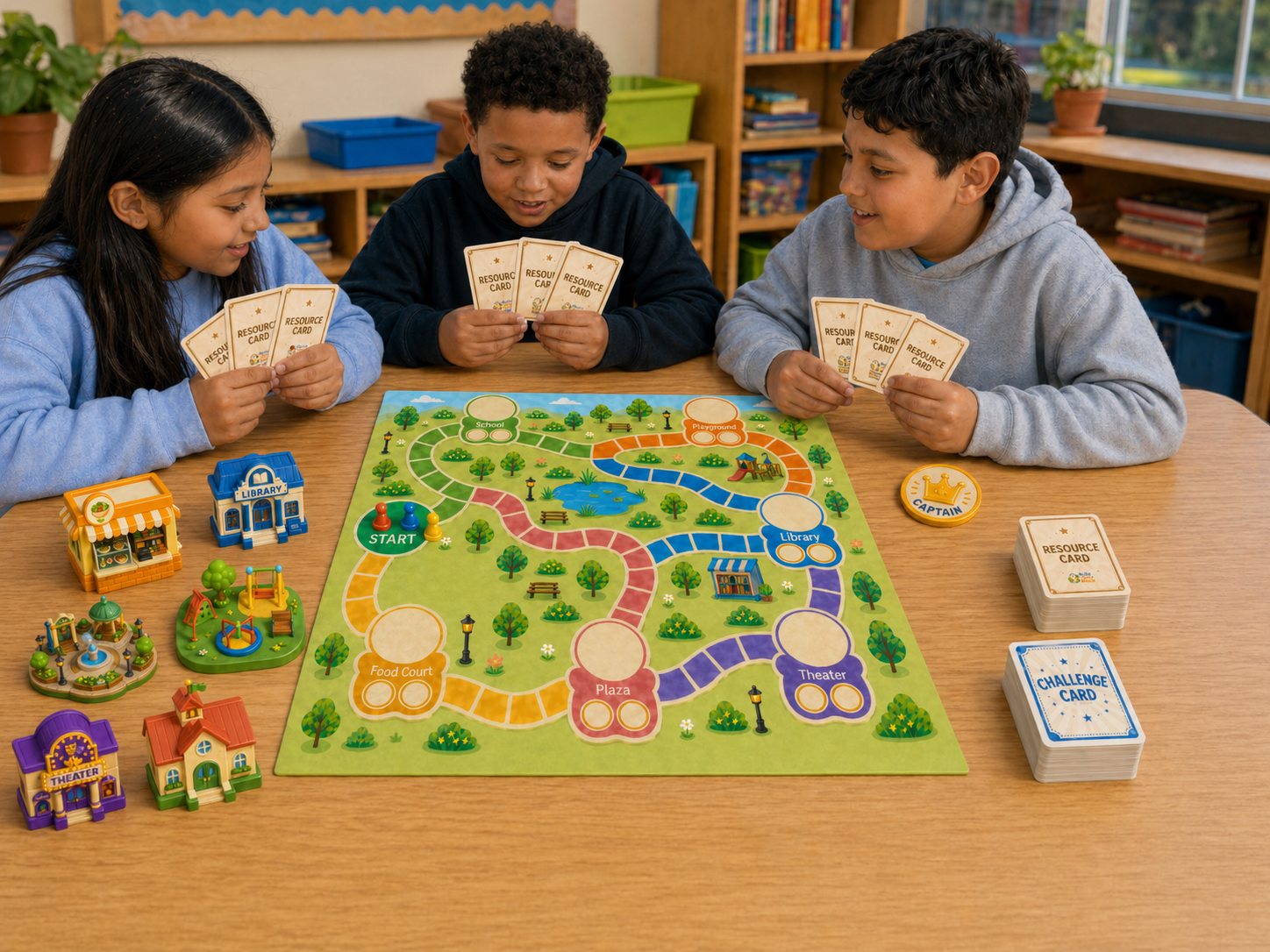
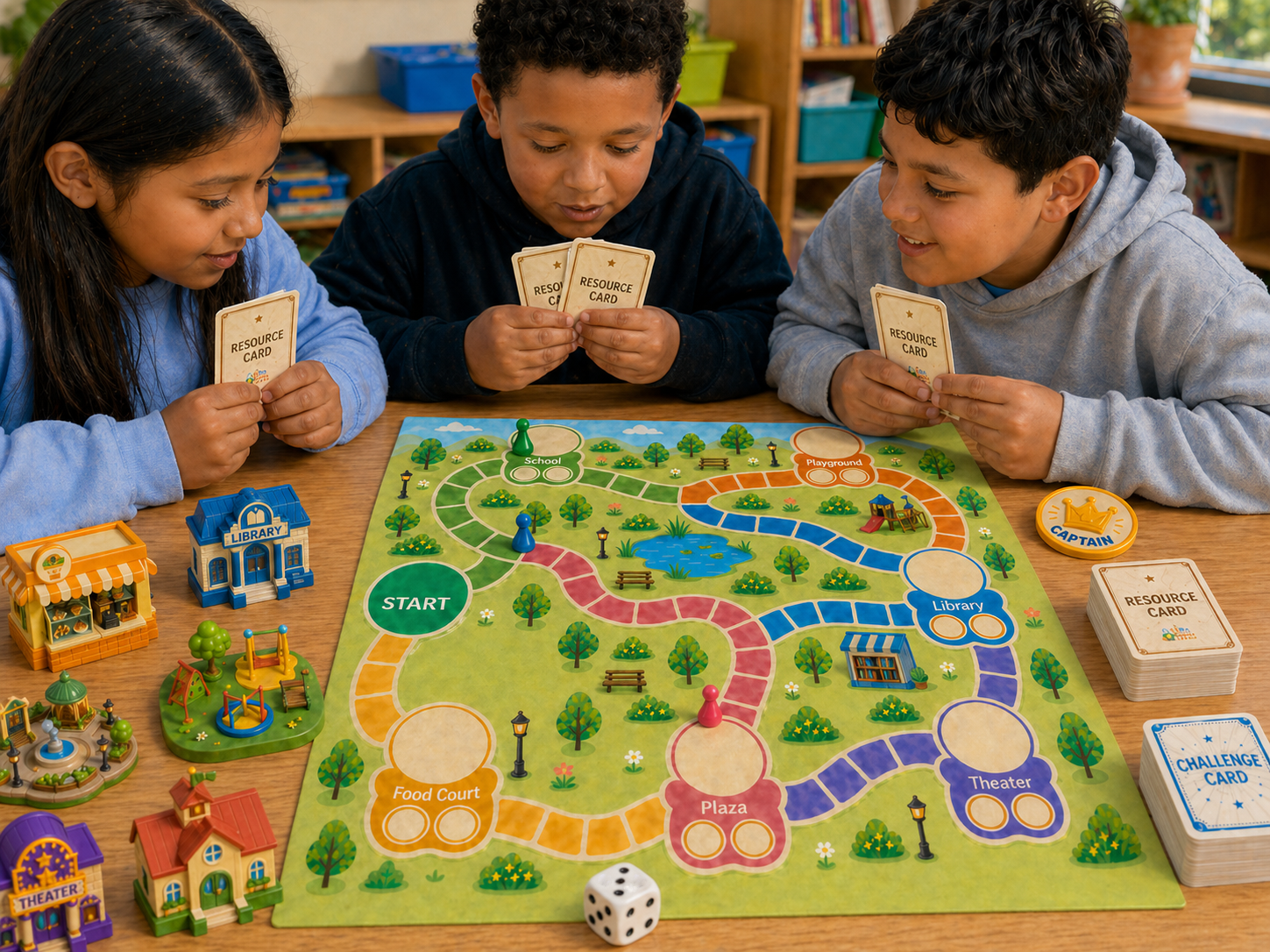
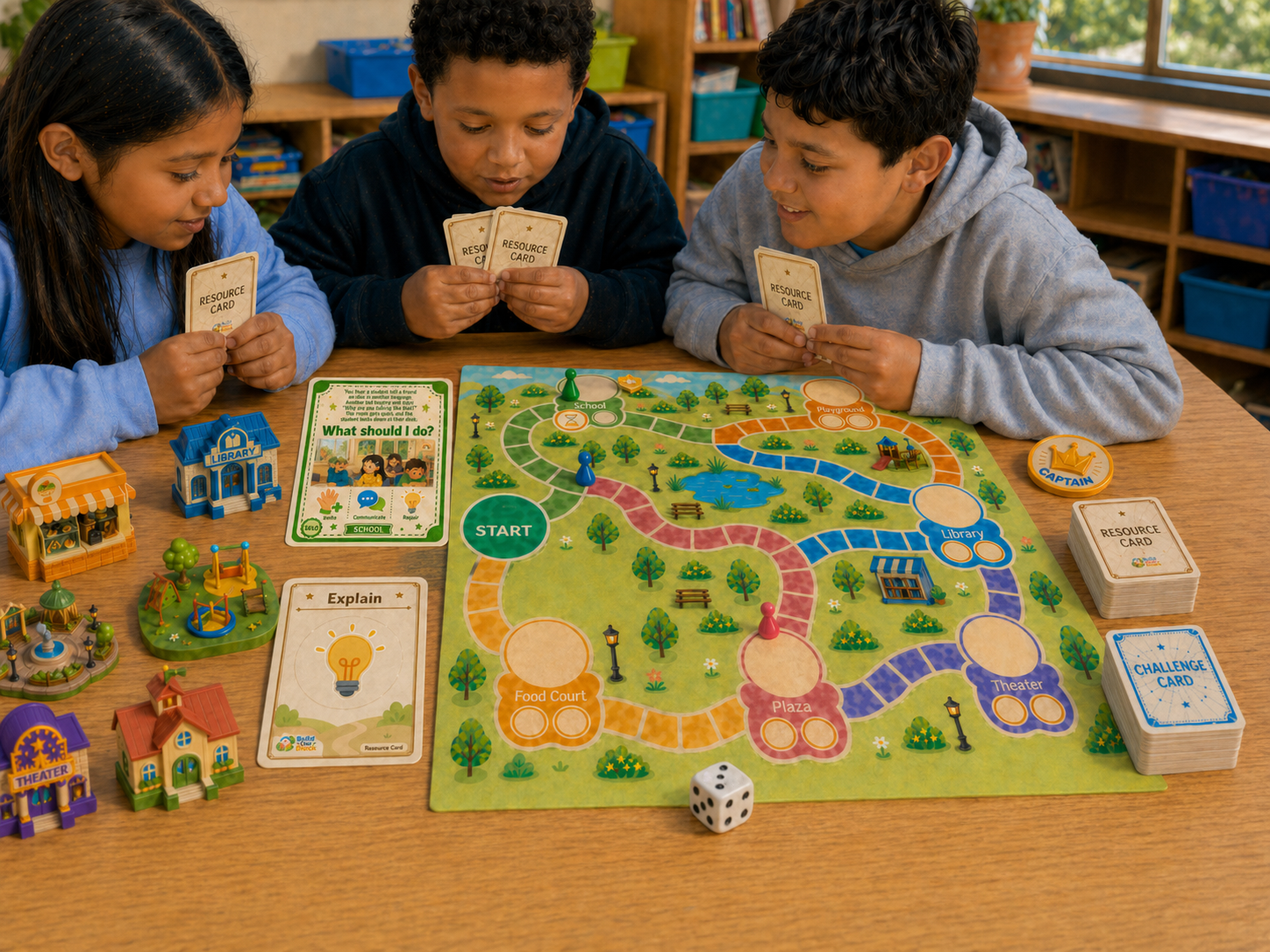
A collaborative building project that invites learners to imagine neighborhood life through model-making and shared decisions.

  • Community Design
  • Urban Play
  • Collaborative Making
Jingtong Yan

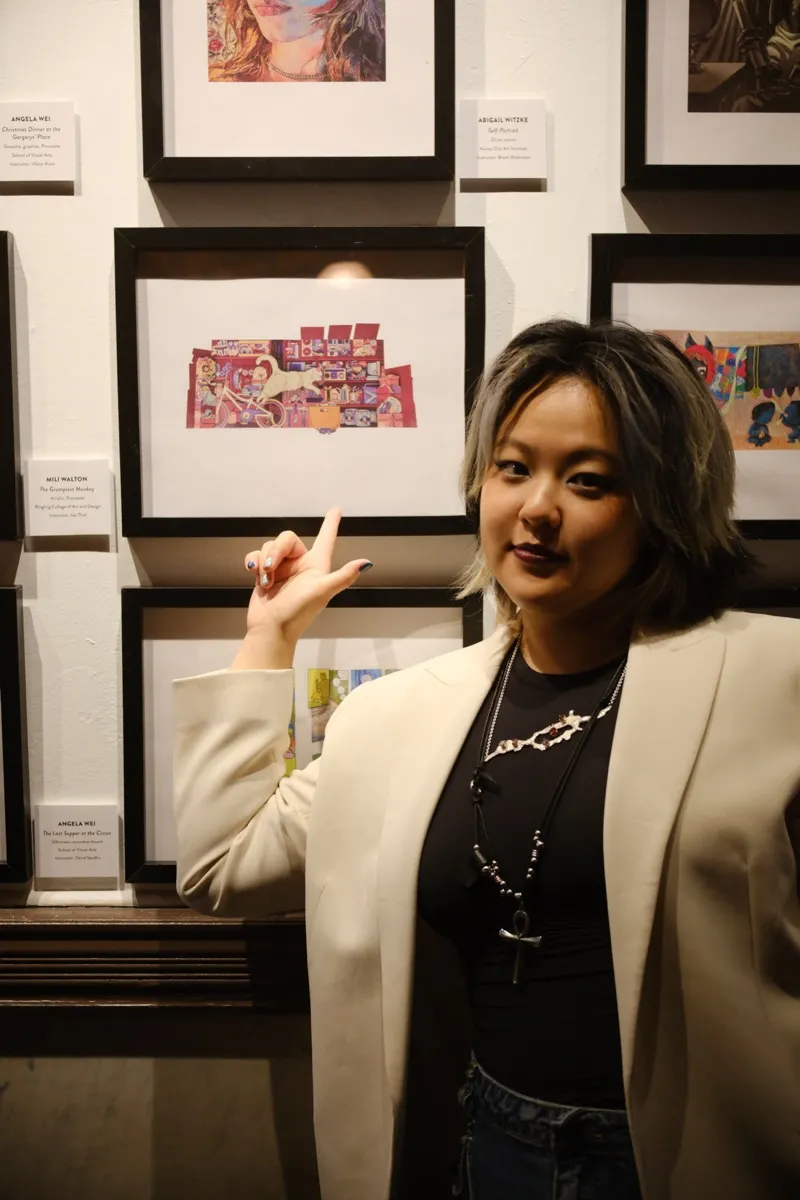
Hi everyone! I'm Jingtong Yan, an illustrator, book artist, and learning designer based in New York City, originally from China. My illustration practice centers on interactive books, including pop-ups, sensory books, and playbooks, alongside editorial illustration and motion work. I create work intended to function across both print and digital media.

My books are designed for children, providing learning experiences through interaction, though they are made to be accessible to all audiences.

As both a teaching artist and curriculum developer, I take a constructionist approach to education, focusing on play-based, informal learning environments where learners develop social-emotional skills through arts-integrated, interdisciplinary practice.

Get in touch: jingtongillustration@gmail.com

Education

Harvard University

EdM Teaching and Teacher Leadership

Arts & Learning Concentration

2025 – 2026
School of Visual Arts

BFA Illustration

2021 – 2024

Awards

Communication Arts

Photography: Unpublished · Shortlist

2026
World Illustration Awards

New Talent: Publishing · Shortlist

2025
American Illustration 44

Chosen

2025
Society of Illustrators

Student Competition · Winner

2025
iJUNGLE Illustration Awards

New Talent · Merit Award

2024
Creative Quarterly 77

Illustration: Student · Winner

Illustration: Student · Runner-Up

2024
Hiii Illustration

Uncommissioned · Finalists

2023
3x3 International Illustration Show No. 21

Student Show · Honorable Mention

2024

Exhibitions

Through Our Eyes

Cambridge

2026
Society of Illustrators Student Competition Exhibition

New York

2025
Hiii Illustration Exhibition

Hangzhou

2024–2025
The Holy Art – Art on Loop Digital Exhibition

London and Athens

2024
NY Art Book Fair (With RisoLAB)

New York

2024
Senior Show

New York

2024
MoCCA Arts Fest (With RisoLAB)

New York

2023, 2024
L'etincelle Art Space GEN-Z Exhibition

Shanghai

2021
Omni Art Expo

Shanghai

2021

Publications & Media

BoldJourney
2025
WIA Shortlist Showcase – Publishing Category Highlights
2025
CanvasRebel
2025
Creative Quarterly Annual
2025
3x3 Annual No.21

3x3 Magazine

2024
Visual Arts Journal
2024
SVA Style

The Visual Arts Press

2023
Hatchlings Textbook

Foreign Languages Press

2020

My Senses Garden

  • Multisensory
  • Play-Based Learning
  • Interactive Book
  • Inclusive
  • Experiential
  • Embodied

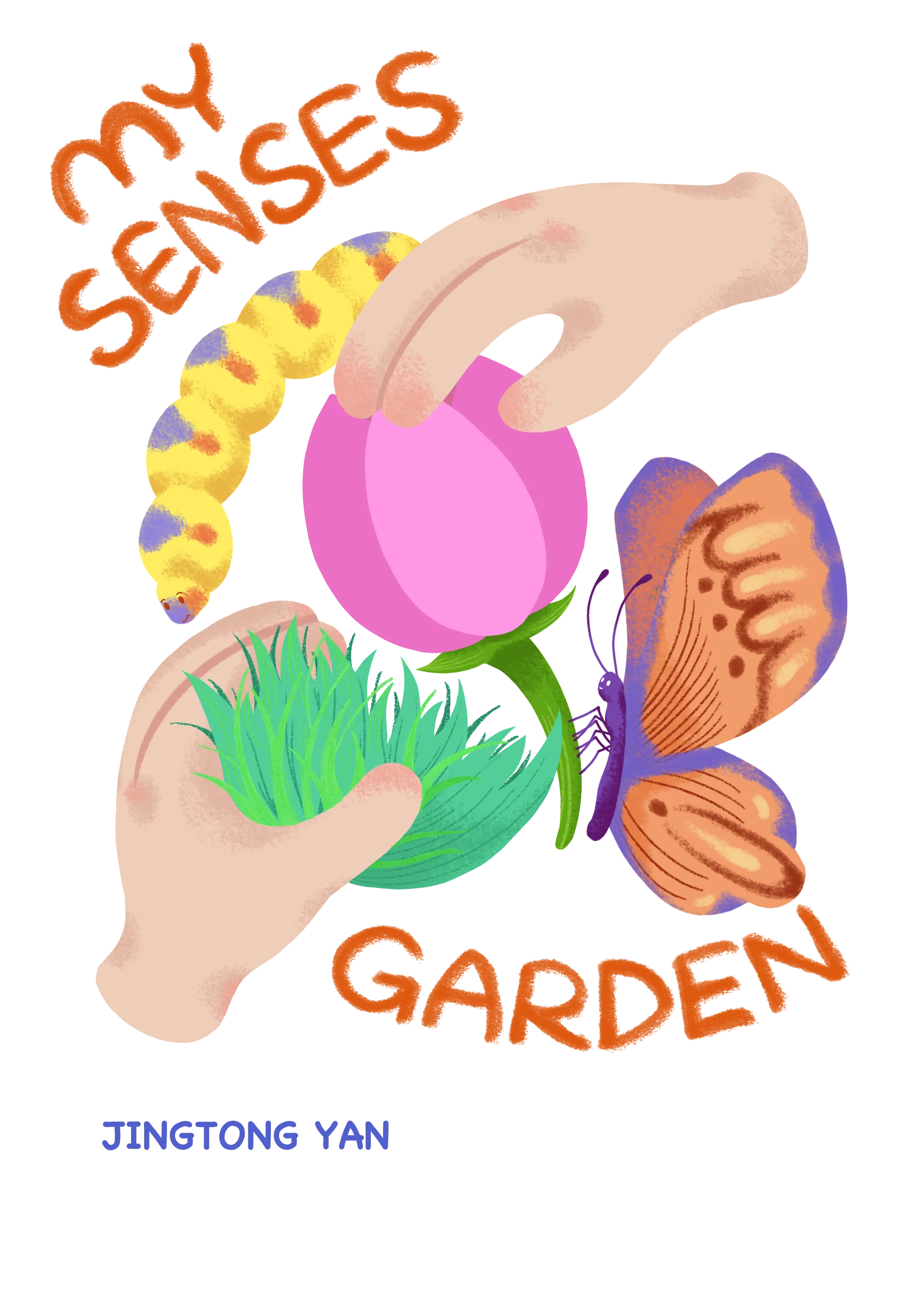
My Senses Garden is an interactive sensory book for children aged 1–4 and their caregivers. It turns reading into a hands-on, multisensory experience where readers explore a “garden” through touch, sound, smell, taste, and sight.

Each spread pairs bold digital illustrations printed on fabric with embedded tactile, auditory, and olfactory elements. Rather than following a fixed narrative, the book uses open-ended prompts that encourage pausing, choosing, and repeating, so the child can lead at their own pace while the caregiver supports the experience through shared discovery.

The Challenge

Most board books for toddlers rely on a single mode of interaction: look and listen. Yet research in early childhood development shows that children aged 1–4 learn best when multiple senses are engaged at once. This project set out to design a reading experience that brings touch, sound, smell, taste, and sight together, while keeping the caregiver–child dynamic natural rather than instructional.

My Role

  • Sole designer, responsible for concept development, learning design, illustration, material research, and physical prototyping
  • Led informal observation sessions with toddlers and caregivers to test how sensory elements and interaction flow performed in practice
  • Iterated through three rounds of prototyping, refining material choices, page structure, and prompt language based on observed behaviour

Audience & Context

  • Children aged 1–4, particularly those in early sensory and language development
  • Caregivers (parents, educators, therapists) as co-readers and facilitators
  • Suitable for home reading, early childhood classrooms, and therapeutic settings

Research & Framework

  • Grounded in embodied cognition, where learning happens through bodily interaction with materials, not just looking at pictures
  • Inspired by Reggio Emilia’s “hundred languages” principle, which recognises that children build meaning through many expressive and sensory channels at once
  • Follows a Vygotskian model of guided participation, where the caregiver’s role grows naturally out of the book’s interactive structure rather than being spelled out

Learning Objectives

  • Help children notice differences in texture, sound, and scent through direct comparison
  • Build descriptive language by naming what they feel and experience (soft, rough, crunchy, sweet) during shared reading
  • Give children space to practise making choices and leading their own exploration
  • Strengthen joint attention and turn-taking between caregiver and child through built-in interactive moments

Experience Walkthrough

This video shows a full reading session and how tactile, auditory, and olfactory elements come together to create a layered interaction between the child, the book, and the caregiver.

View My Senses Garden in Books & Prints →

Interaction Design

  • Pressing and squeezing activate hidden squeakers, creating a cause-and-effect loop that rewards curiosity
  • Crinkly fabric pages produce sound through touch, connecting what the child does with what they hear
  • Spice patches (cinnamon, star anise) release scent when rubbed, bringing smell into the story
  • Varied textures across spreads (plush, rough, smooth) slow the reader down and draw attention to what each page feels like
  • Layered pockets and flaps invite repeated discovery, so each re-reading can surface something new

Design Rationale

  • Fabric over paper, because the softness makes it feel safe to touch and explore, especially for very young readers
  • There is no fixed reading order. Open-ended navigation lets the child set the pace and build a sense of autonomy, which is a key goal in early childhood pedagogy
  • Sensory elements are stitched directly into the pages rather than attached on top. This makes them more durable and feels like a natural part of the reading experience
  • The illustration style uses bold, simplified forms. High-contrast shapes are easier for young children to read and help guide their attention toward interactive areas
  • Caregiver prompts are suggestive rather than directive. “What do you feel?” instead of “Touch this” leaves space for the child’s own language and interpretation

Impact & Insights

  • Children spent noticeably more time on pages with layered interactions (texture + sound), suggesting that multisensory complexity holds attention better than single-mode pages
  • Caregivers naturally shifted from reading aloud to asking questions and narrating what the child was doing. The book’s structure repositioned them as facilitators without anyone having to tell them to
  • Each re-reading surfaced new interactions, which extended the book’s learning lifespan and confirmed that the open-ended design approach was working
  • The strongest moments of joint attention happened when both child and caregiver were physically touching the same page. That shared tactile experience created a connection that visual-only reading simply could not
  • Scent turned out to be the most unexpectedly powerful element. It triggered spontaneous conversations about food, memory, and personal associations for both children and adults

Discovering Science Through Art

  • STEAM
  • Curriculum Design
  • After-School Program
  • K–5
  • Inquiry-Based
  • Workshop Design

Discovering Science Through Art is a 9-week after-school STEAM curriculum designed for elementary school students through the Togetherhood platform, which connects enrichment providers with schools to deliver after-school programming. Each weekly session pairs a hands-on art project with a core science concept, turning material exploration into a way of understanding ideas like surface tension, density, magnetism, and chemical reactions.

Rather than teaching science and art as separate subjects, the curriculum uses art-making as the primary mode of scientific inquiry. Students learn by doing: mixing, pouring, pressing, and observing what happens, then reflecting on what they noticed and why.

The Challenge

The core design question was: how do you help elementary students grasp abstract science concepts like surface tension, density, and chemical reactions in a one-hour weekly session, without turning it into another lecture? The constraints were real: mixed grade levels, limited materials budget, and only 30 minutes of hands-on time per session.

My Role

  • Sole curriculum designer and lead instructor for the full 9-week programme
  • Designed all lesson plans, sourced and purchased materials independently, and facilitated every session
  • Developed a repeatable class structure (engagement, demo, concept, hands-on, reflection) and adapted it week by week based on student responses

Audience & Context

  • Elementary school students in an after-school enrichment setting (Togetherhood programme)
  • Mixed grade levels with varying prior experience in both art and science
  • Weekly 1-hour sessions across one semester

Research & Framework

  • Rooted in arts-integrated STEAM pedagogy, where art-making is the vehicle for scientific inquiry rather than a supplement to it
  • Each session follows a consistent structure: engagement prompt, science concept introduction, hands-on studio time, and guided reflection
  • Scaffolding builds across the semester, with later sessions referencing and combining concepts from earlier weeks (e.g. Week 7 Lava Lamp combines density from Week 5 with chemical reactions from Week 6)

Learning Objectives

  • Build intuitive understanding of science concepts (surface tension, density, chemical reactions, magnetism, pH) through direct material exploration
  • Develop scientific observation skills by noticing cause-and-effect during art-making
  • Practise descriptive vocabulary by naming what they see, feel, and discover during reflection
  • Strengthen comfort with experimentation, where unexpected results are valued rather than corrected

Curriculum Overview

The 9-week sequence is designed so that concepts build on each other. Early sessions introduce single ideas (absorption, magnetism), while later sessions layer multiple concepts together.

WeekProjectScience Concept
1–2Salt + Paint Path PaintingAbsorption, Capillary Action
3Painting with MagnetsMagnetic Force
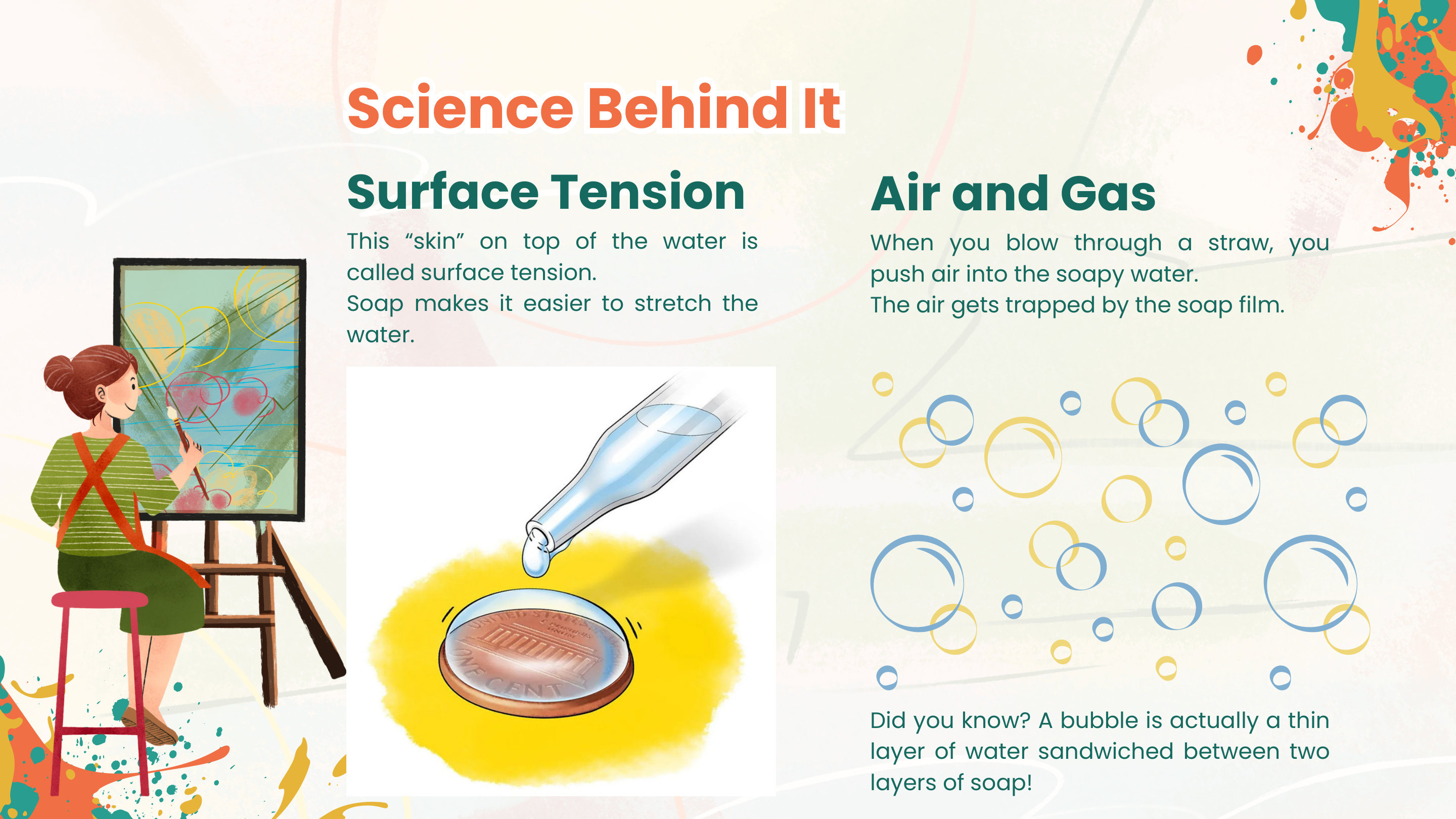
4Bubble PrintsSurface Tension, Air & Gas
5Marble PrintsDensity, Oil & Water
6Pokémon Power PaintingChemical Reaction, CO₂
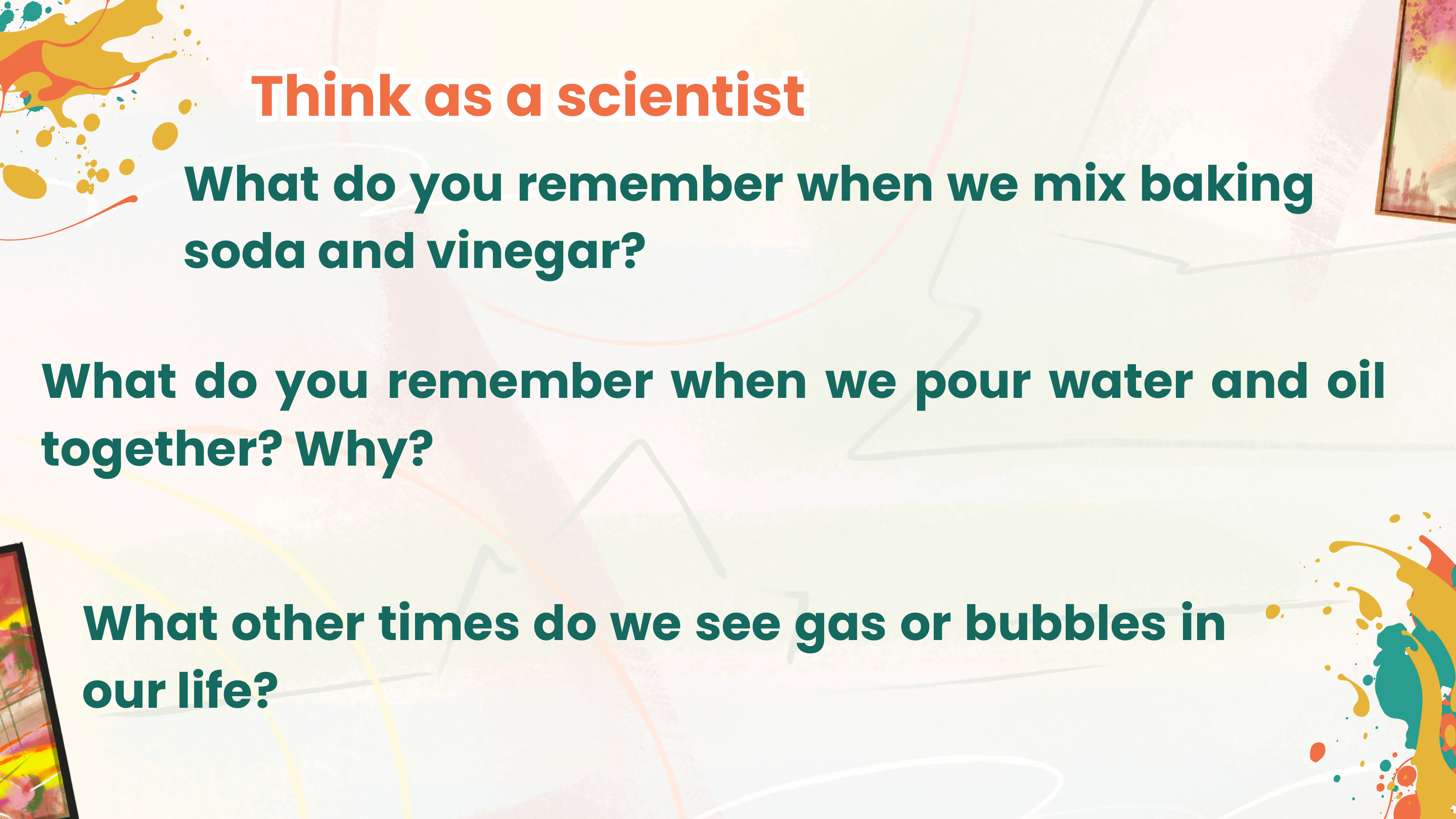
7Lava LampDensity + Chemical Reaction (combined)
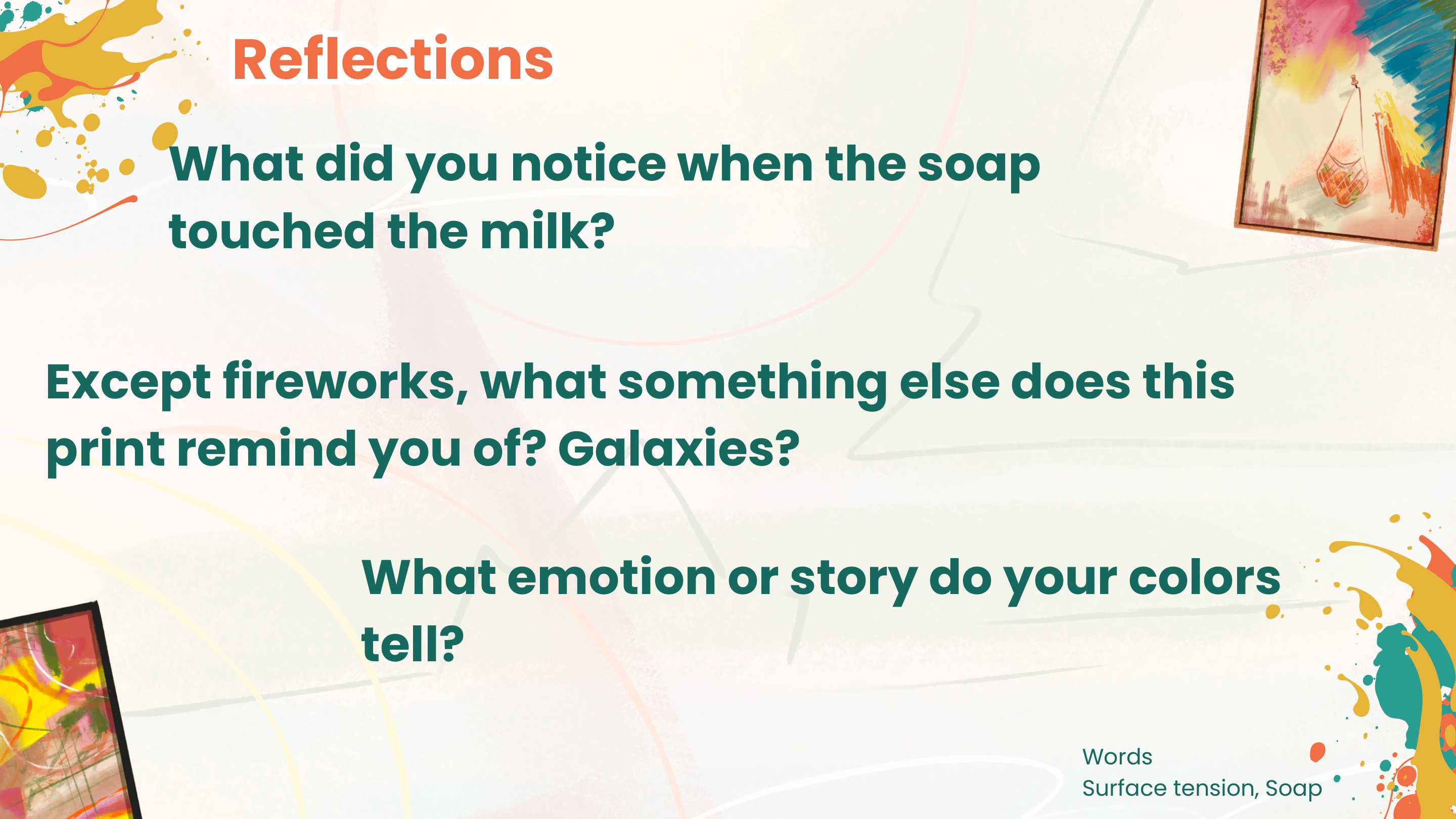
8Milk FireworkSurface Tension + Soap
9pH ArtAcids, Bases, Anthocyanin

Teaching Materials

Each session is supported by a slide deck that walks students through the science concept, step-by-step instructions, and reflection prompts. Below are three representative examples showing how the slides handle concept translation, curriculum sequencing, and reflective facilitation.

Week 4 Bubble Prints teaching slide - Science Behind It Week 7 Lava Lamp teaching slide - Think as a scientist Week 8 Milk Firework teaching slide - Reflections

Week 4: Bubble Prints — Science concept explained in child-friendly language

View full teaching slides on Canva:

  • Week 4: Bubble Prints →
  • Week 7: Lava Lamp →
  • Week 8: Milk Firework →

Design Rationale

  • Art-first framing lowers the barrier to entry for students who may not see themselves as “science kids”
  • A consistent session structure (3 min intro, 8 min demo, 5 min concept, 30 min hands-on, 4 min reflection) gives students predictability while allowing creative freedom within it
  • Concepts are sequenced so that later sessions build on earlier ones. Density reappears, chemical reactions combine with previous ideas
  • Reflection prompts are open-ended and personal (“What surprised you?”, “What would you try differently?”) rather than quiz-style
  • Culturally relevant hooks (Pokémon Power Painting) increase buy-in by connecting science to things students already care about

Student Work

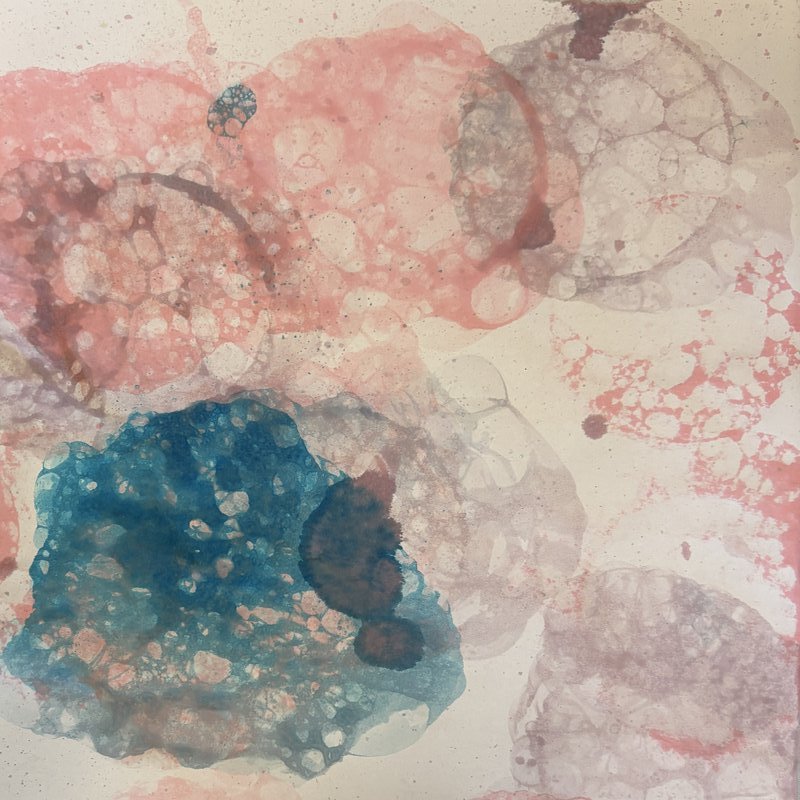
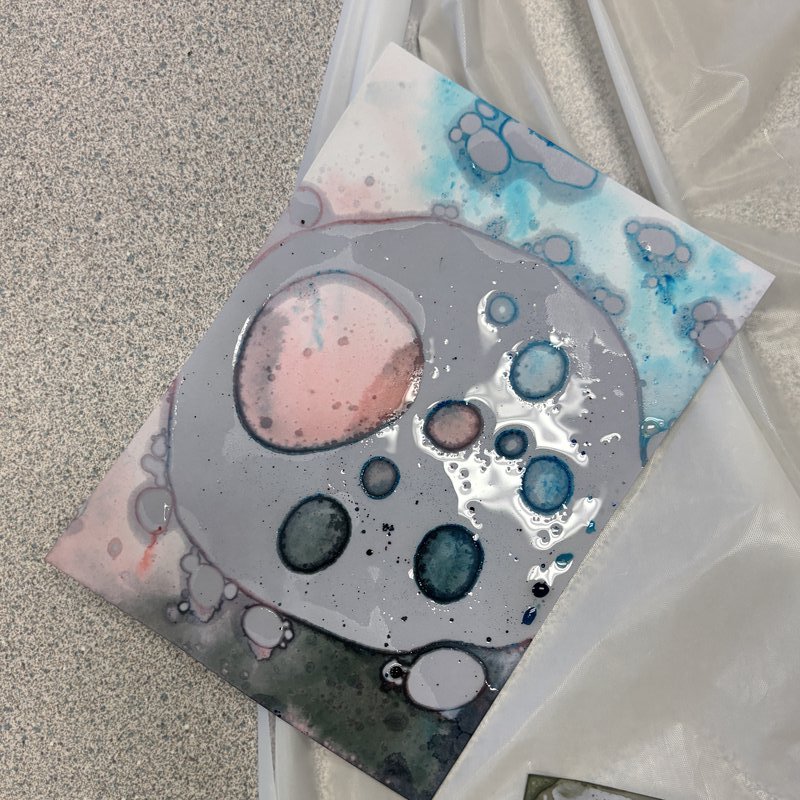
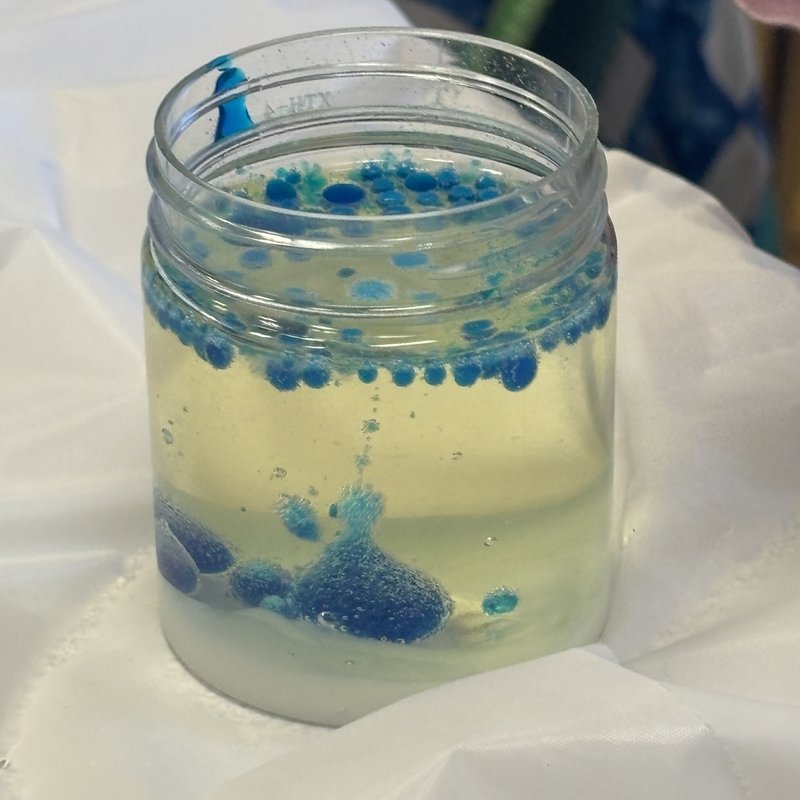
A selection of student work from across the semester, showing the range of outcomes produced through the same activity structures.

Student bubble prints artwork
Bubble Prints — Surface Tension
Student marble prints artwork
Marble Prints — Density
Student lava lamp artwork
Lava Lamp — Density + Chemical Reaction

Impact & Insights

  • Students increasingly used science vocabulary unprompted during later sessions. Terms like “density” and “chemical reaction” appeared in Week 7 reflections without being reminded
  • The consistent class structure reduced transition time from around 5 minutes in early weeks to around 3 minutes by mid-semester, creating more studio time
  • Pokémon Power Painting (Week 6) was the highest-engagement session, suggesting that connecting science to familiar cultural references significantly boosts participation
  • Students who were initially hesitant to experiment became more willing to try unexpected combinations as the semester progressed, indicating growing comfort with open-ended inquiry
  • The “Bring it, bring it… Back!” call-and-response became a student-requested ritual, showing that small community-building routines matter as much as content design

Pieces of Growing Up

  • SEL
  • Inclusive
  • Game-Based Learning
  • K–1 Transition
  • User Research
  • Collaborative

Pieces of Growing Up is a classroom-based social-emotional learning experience designed for first-grade students transitioning from kindergarten to elementary school in China. The project combines short narrative videos with a physical puzzle decision-making activity, where students guide the main character through everyday school scenarios by selecting puzzle pieces that reflect appropriate social-emotional responses.

Developed as a group project for Harvard EDU T566: Learning Design for All, the experience follows a Prep–Watch–Decision–Discuss cycle that gives students immediate, non-punitive feedback through color-coded puzzle pieces while teachers facilitate reflection and discussion.

The Challenge

In China, the transition from kindergarten to first grade focuses almost entirely on academic readiness, leaving social-emotional development largely unsupported. First graders suddenly move from play-based environments into structured classrooms where they are expected to follow rules, sustain attention, regulate emotions, and collaborate with peers. In Anhui Province, where class sizes are large and teacher training resources are limited, this gap is particularly visible. The project needed to deliver SEL support without adding preparation burden to already-stretched teachers, using only low-cost materials and existing classroom equipment.

My Role

  • Led audience analysis and problem mapping, identifying the SEL gap across students, teachers, and parents
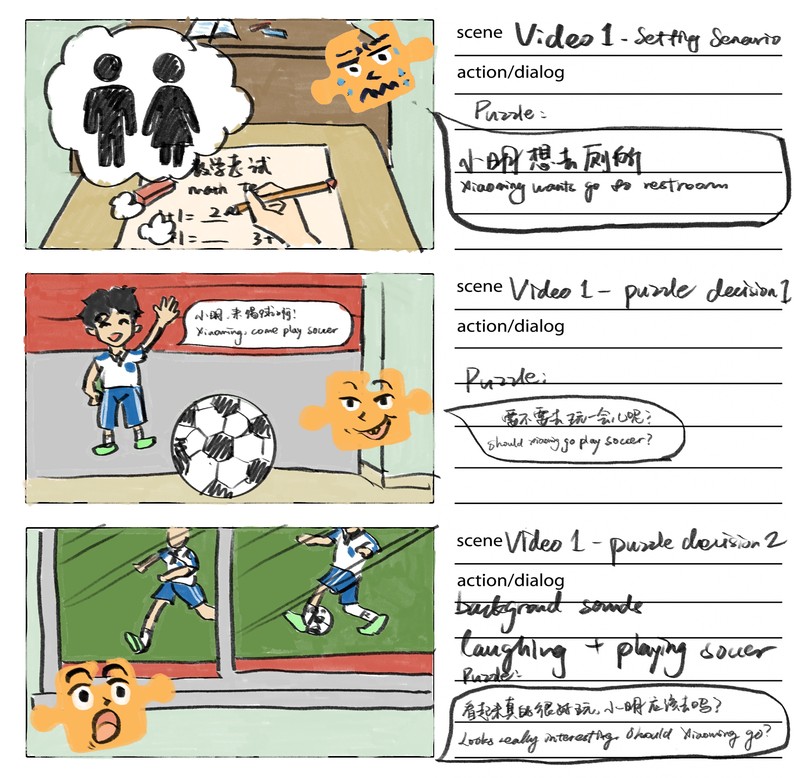
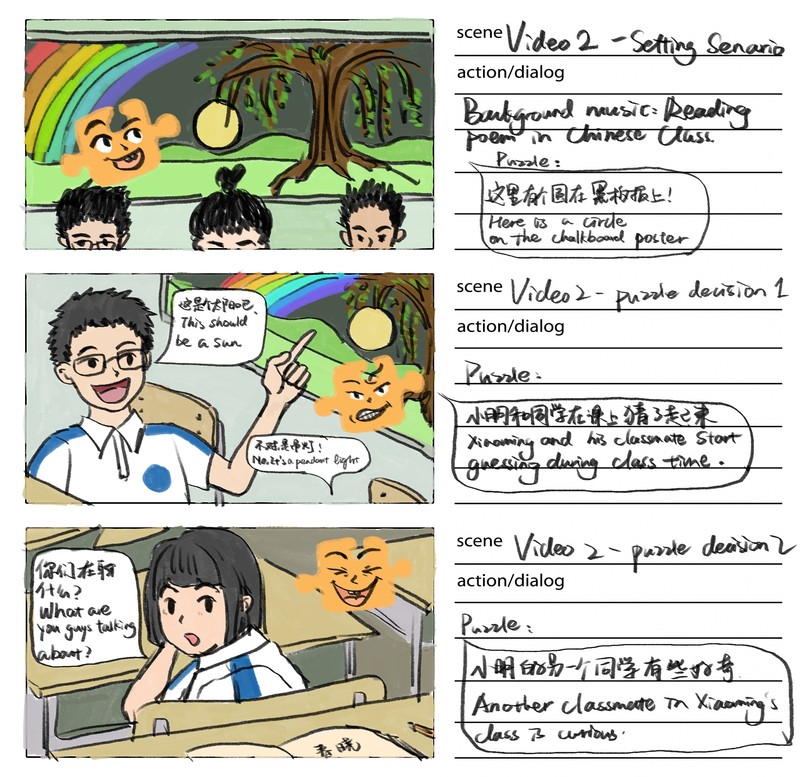
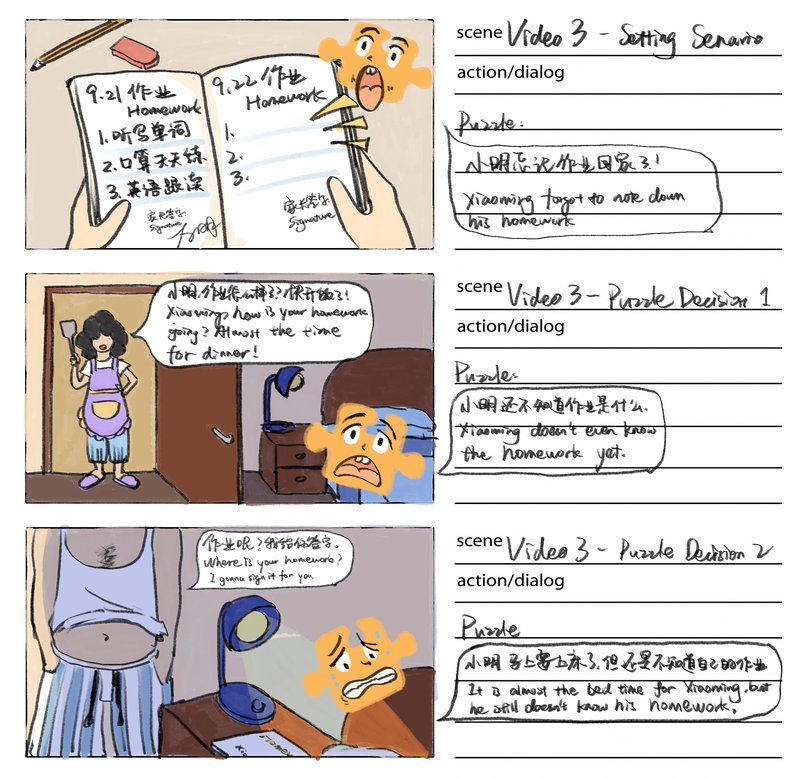
  • Produced all storyboards for the video scenarios, translating learning objectives into visual narratives
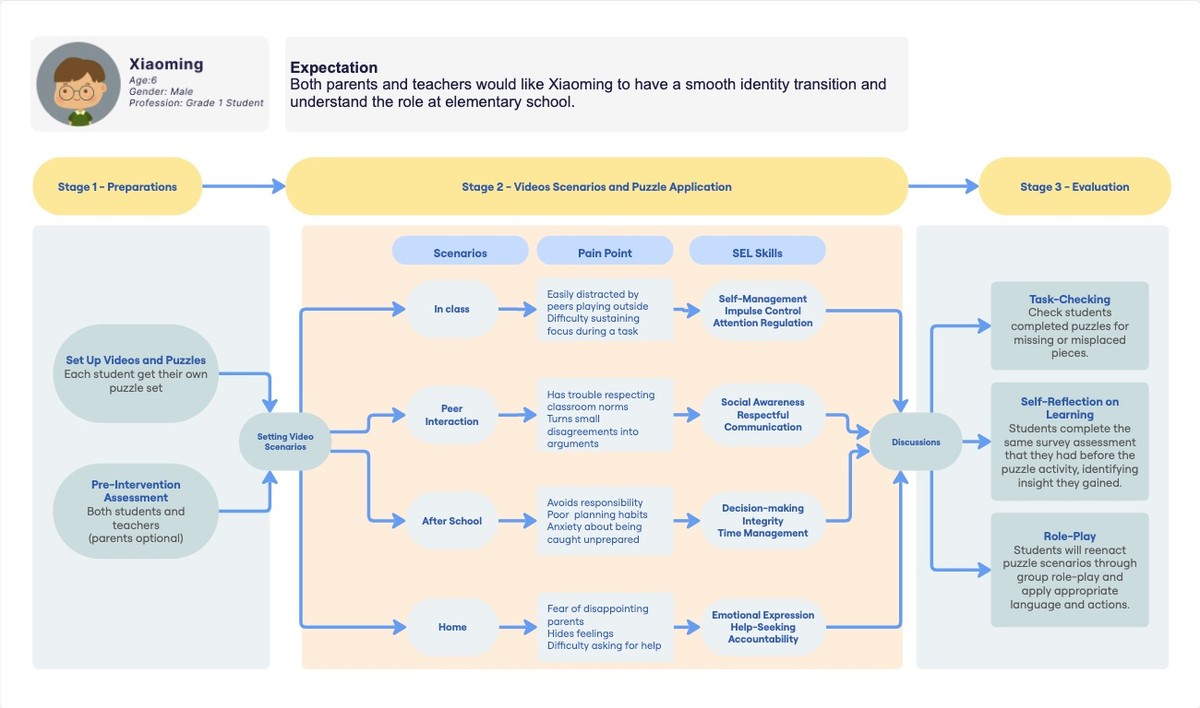
  • Designed the learning journey map outlining the full Prep–Watch–Decision–Discuss activity cycle
  • Contributed to user research interviews and formative evaluation design

Team & Context

  • A collaborative project for Harvard EDU T566: Learning Design for All
  • Team of four: Jingtong Yan, Jiayi Dai, Victoria Wu, Jay Qu
  • Designed for first-grade students (age 6–7) transitioning from kindergarten to elementary school in Anhui Province, China

Research & Framework

  • Universal Design for Learning (UDL): multiple means of engagement and expression through video, physical puzzles, and group discussion
  • Culturally Responsive Teaching: all scenarios are drawn from real Chinese school-life situations that students recognise from their own experience
  • Trauma-Informed Practice: wrong choices are treated as exploration opportunities rather than mistakes to be corrected
  • Formative evaluation through 6 semi-structured interviews with educators across urban and rural backgrounds, leading to concrete design iterations

Learning Objectives

  • Develop early self-monitoring and task-checking habits through puzzle completion and self-review
  • Build metacognitive awareness through structured pre/post visual reflection activities
  • Practise emotion recognition, perspective-taking, and cooperative behaviour through scenario-based decision-making
  • Transfer SEL understanding into real-world social behaviour through guided group role-play
  • Foster growth mindset thinking by helping students name emotions and connect behaviours with outcomes through visual reflection

How It Works

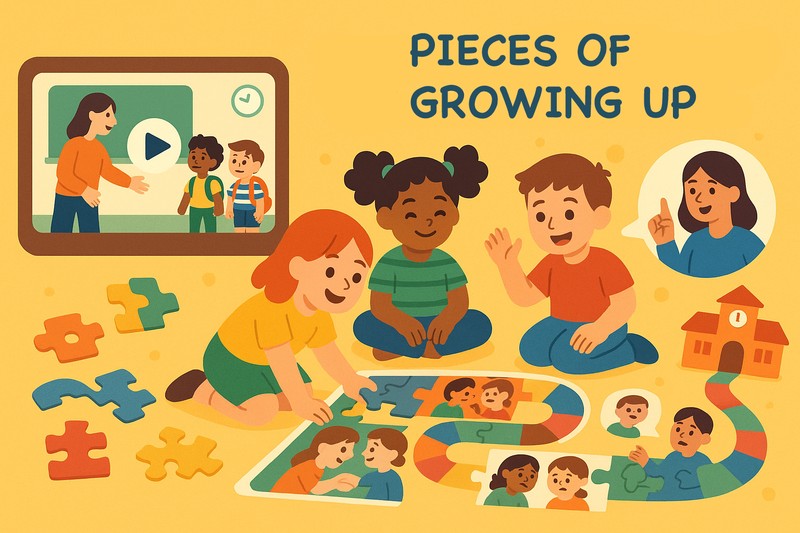
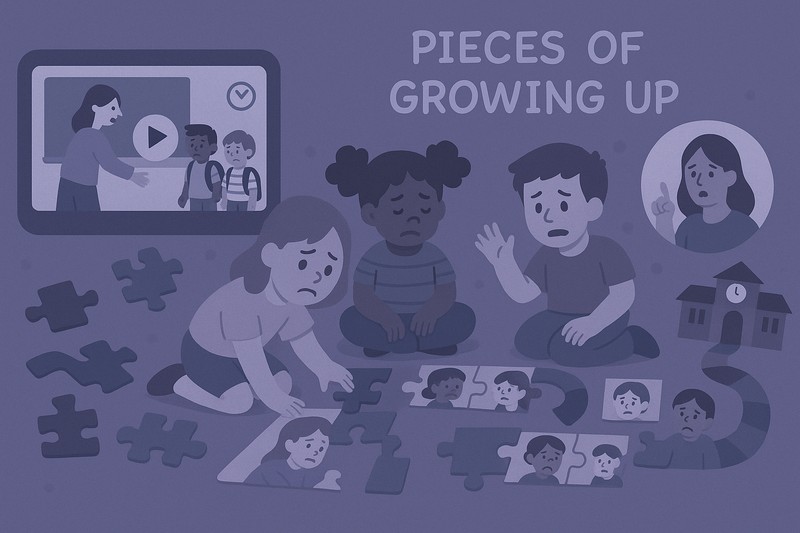
The experience follows a four-stage learning cycle. Teachers set up materials and run a quick pre-assessment. Students then watch four short videos where the main character Xiaoming encounters familiar school-life scenarios. At each decision point, the video pauses and students choose from face-down puzzle pieces (gray side up), each marked with a simple cue—a letter, number, or icon—that corresponds to a possible response. After selecting a piece and placing it on the puzzle board, its color is revealed: yellow pieces represent more appropriate social choices and fit together into a bright, complete image, while blue pieces indicate less appropriate choices and create visible mismatches. After all scenarios, teachers lead a reflective discussion connecting the choices to emotions and social rules.

Pieces of Growing Up learning journey map — click to enlarge

Storyboard & Visual Design

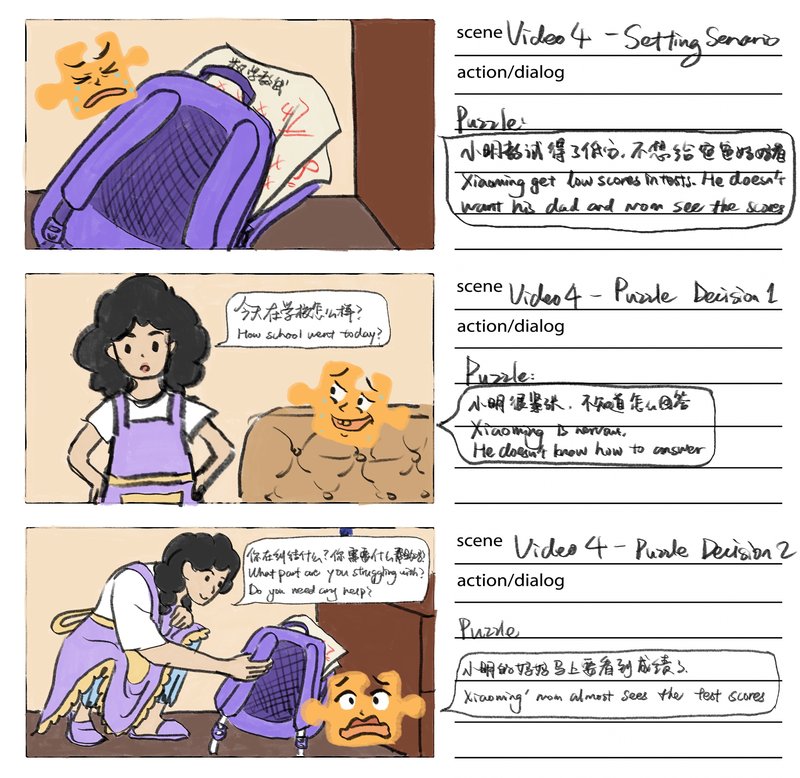
The storyboards translate each learning scenario into a visual sequence, from the initial situation through the decision point to the consequence. The final puzzle illustrations show the contrast between appropriate and less appropriate choices.

Storyboard for Video 1 - classroom scenario Storyboard for Video 2 - peer interaction scenario Storyboard for Video 3 - family scenario Storyboard for Video 4 - test scores scenario Completed puzzle - all appropriate choices Mismatched puzzle - less appropriate choices

Storyboard: Video 1 — Classroom scenario with decision points

View full project presentation and learning experience walkthrough video →

Design Rationale

  • Puzzle-based gamification provides immediate, non-punitive feedback through colour coding rather than binary right/wrong judgement
  • Video scenarios grounded in real first-grade experiences create emotional resonance and lower the barrier to participation
  • Teacher guidance cards reduce preparation burden, making the activity accessible even for teachers without SEL training
  • The full activity runs in 30–40 minutes using only a projector and printed puzzle cards, ensuring scalability across both urban and rural schools
  • Consequence animations and repeated temptation scenarios reinforce memory consolidation and behavioural understanding

Impact & Insights

  • Educators across urban and rural contexts validated the “video + puzzle” format as effective and classroom-friendly during formative evaluation
  • Interviewees confirmed that children in transition lack emotional and social readiness regardless of background, reinforcing the project’s core premise
  • Feedback led to concrete design iterations: added teacher guidance cards with SEL focus areas and guiding questions, consequence animations, and visual feedback optimisation
  • The project demonstrates that SEL can be embedded into low-cost, structured classroom activities without requiring extensive teacher training or personal devices
  • The dual feedback system (colour-coded puzzles + facilitated discussion) supports both individual reflection and collective sense-making
Pieces of Growing Up learning journey map — full size

Let’s Make Comics

  • Scaffolded Learning
  • Collaborative
  • Workshop Design
  • Hands-On
  • Sequential Art
  • Youth Voice

A 10-session after-school comic-making workshop for elementary students through the Togetherhood enrichment program. The curriculum progressively builds comic-making skills from basic panel layouts to a finished, coloured comic, covering character design, scripting, backgrounds, inking, zine-making, and collaborative comic jams.

The Challenge

Students came with widely varying drawing abilities and no prior experience with sequential art. The workshop needed to build comic-making skills progressively while keeping each session self-contained enough that students who missed a week could still participate. All instruction had to work within basic classroom supplies—pencils, markers, copy paper, and bristol paper—without access to digital tools.

My Role

  • Designed the full 10-session curriculum from scratch, structuring a progressive skill-building arc from panel basics to a complete final comic
  • Created all teaching slides and reference materials for each session, curating professional comic and manga examples as visual scaffolding
  • Led weekly 2-hour sessions, providing direct instruction and individualised feedback across skill levels
  • Adapted materials for multilingual learners, incorporating bilingual English/Spanish prompts in teaching slides
  • Prepared a detailed substitute lesson plan for one missed session to ensure curriculum continuity

Context

  • Togetherhood after-school enrichment program, New York
  • Elementary students with varying drawing experience
  • 10 weekly sessions (~2 hours each), March–May 2025
  • Basic classroom art supplies only (pencils, markers, fine-liners, bristol paper)

Curriculum Overview

WeekTopic
1Comic strip with panel layouts
2Original character design
3(Substitute session)
4Creating a comic from a story prompt
5Background & setting practice
6Inking techniques
7One-page zine
8Comic Jam (collaborative)
9Final comic — refined pencil sketch
10Final comic — inking & colouring

Teaching Slides

Each session opened with a short visual presentation introducing the week's concept through professional comic and manga examples, followed by step-by-step demonstrations and hands-on practice.

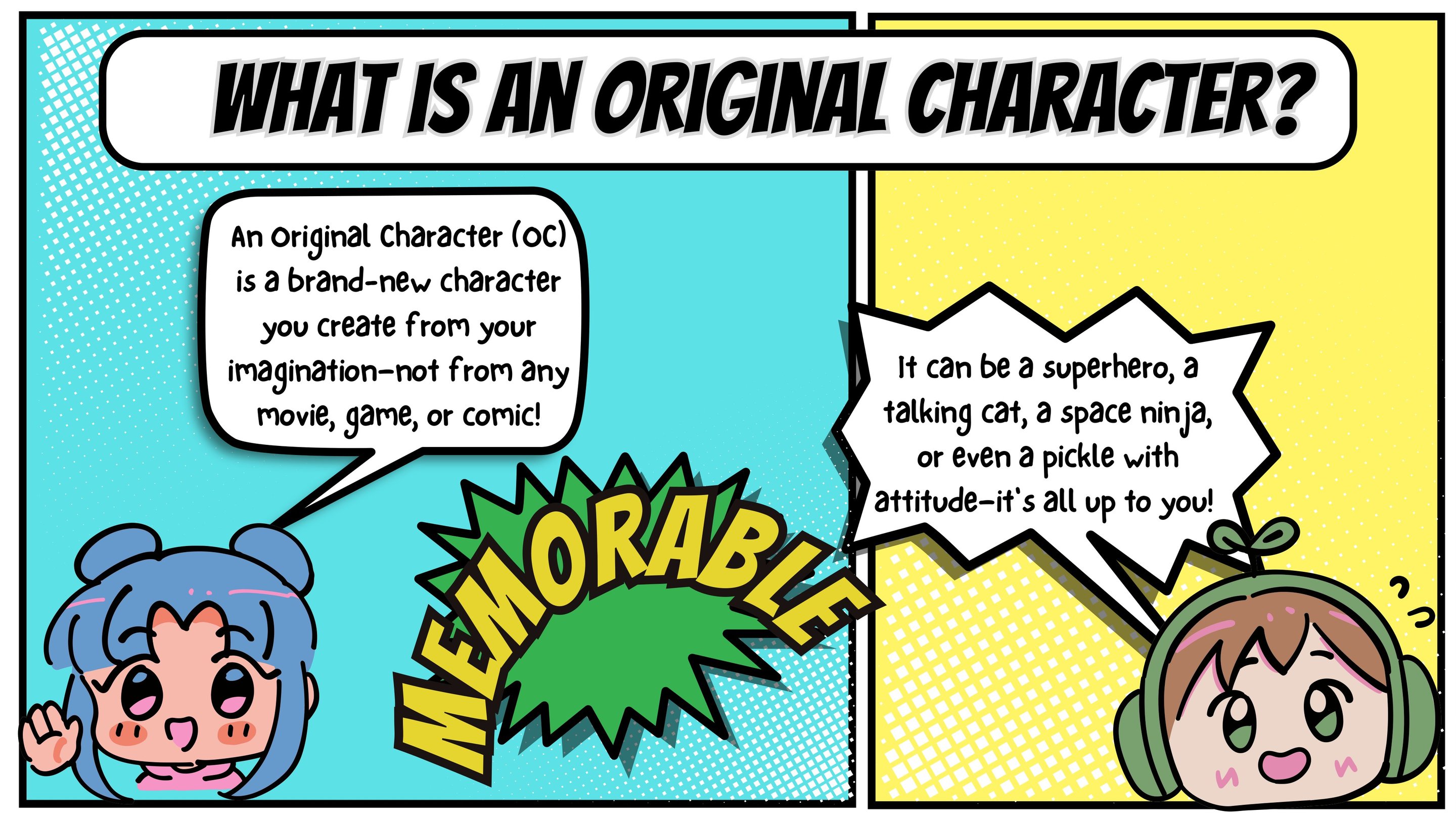
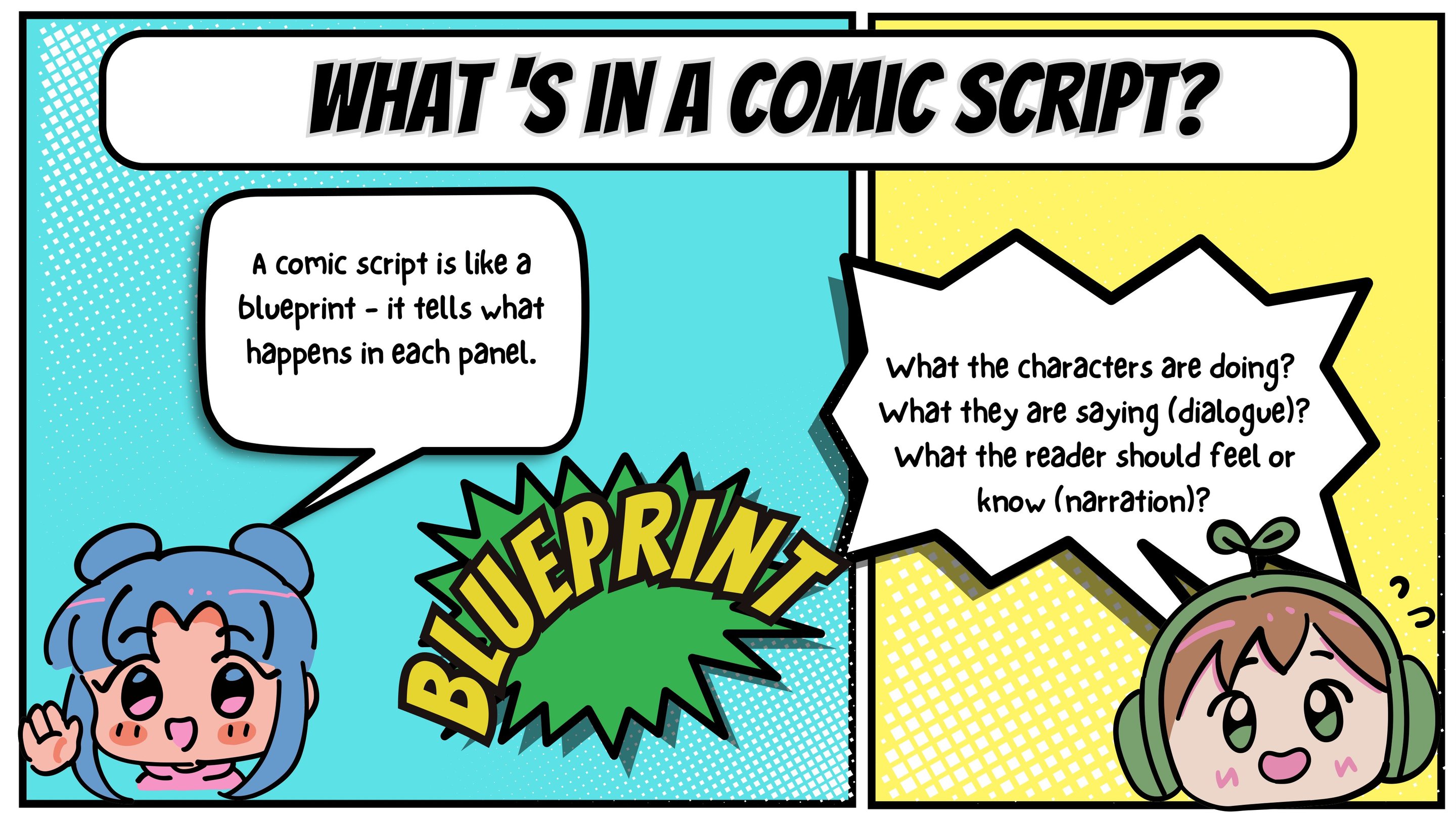
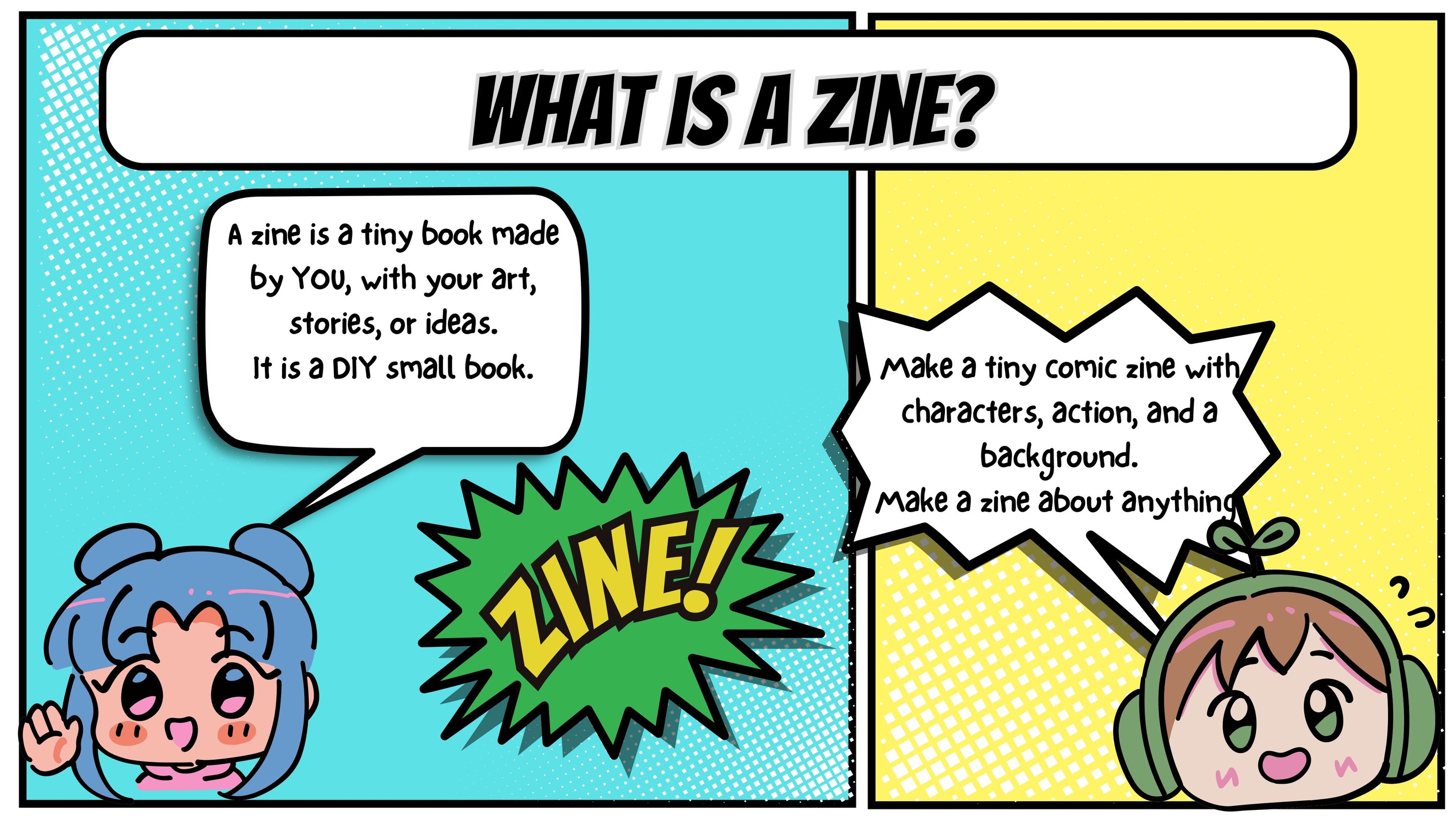
Week 1 teaching slide - comic strip basics Week 2 teaching slide - original character Week 4 teaching slide - comic from a story Week 7 teaching slide - one page zine

Week 1 — Comic strip with panel layouts

View full teaching slides on Canva: Week 1 · Week 2 · Week 4 · Week 7

Teaching Approach

  • Each session structured as: introduction with visual examples, direct instruction and demonstration, hands-on practice, and share-and-feedback
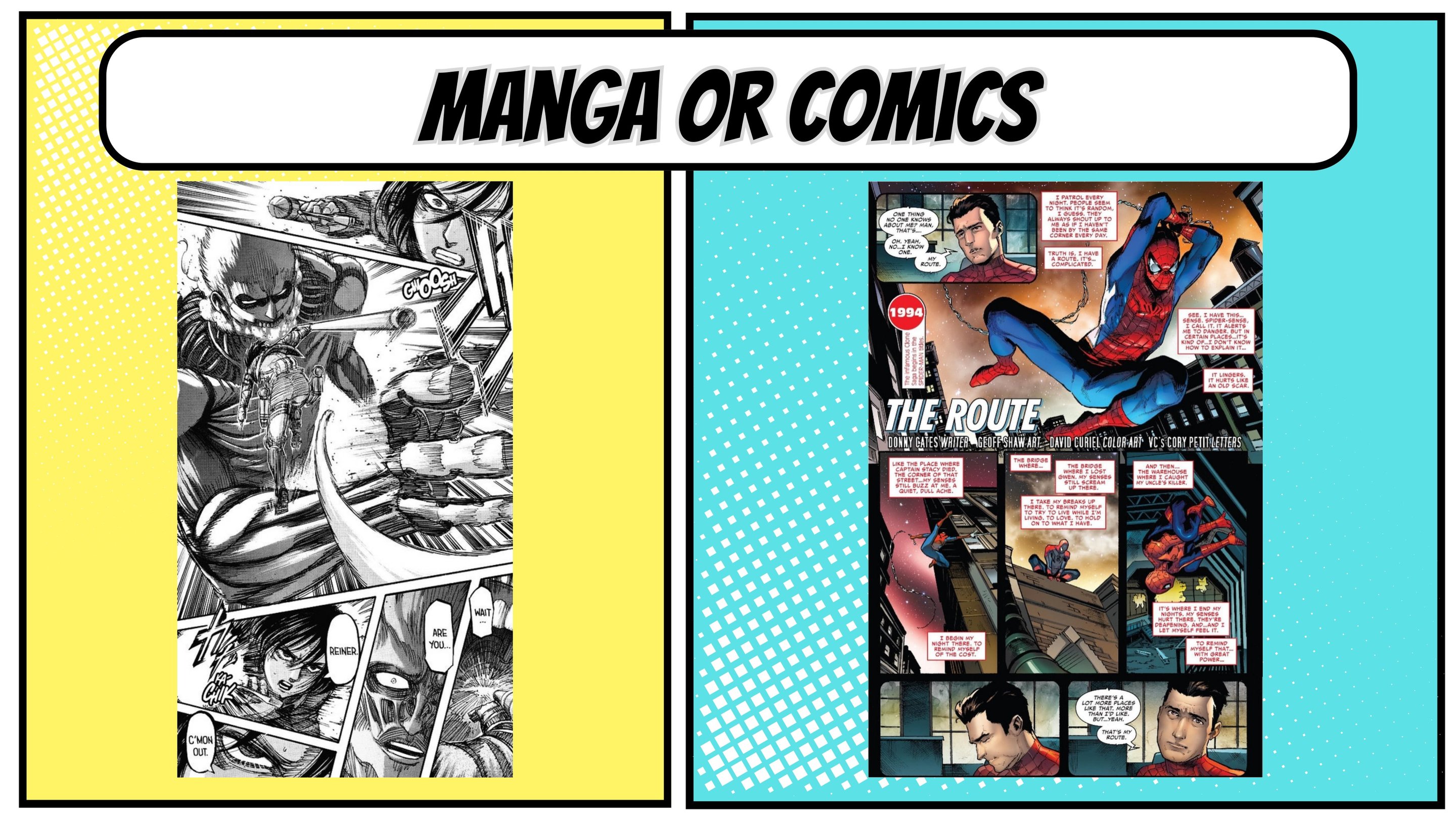
  • Professional comic and manga references (One Piece, Spider-Man, Attack on Titan, Batman) used as visual scaffolding to spark engagement and illustrate techniques
  • Bilingual prompts (English/Spanish) embedded in teaching slides to support multilingual learners
  • Progressive scaffolding: early sessions isolate single skills (panels, characters, scripts), later sessions combine them into complete works
  • One-page zine (Week 7) gives students their first tangible "published" piece before the final two-session project

Design Rationale

  • Building-block curriculum ensures each skill is practised in isolation before being combined into a complete comic
  • Self-contained sessions allow students who miss a week to rejoin without falling behind
  • Comic Jam (Week 8) introduces collaborative storytelling and improvisation, shifting students from individual to group creative processes
  • Final project spans two sessions (sketch then ink/colour) to model a professional comic workflow and give students experience with revision
  • Using students' existing interests (manga, superhero comics, video game characters) as entry points lowers the barrier to participation

Impact & Insights

  • Students progressed from basic panel strips to producing complete, coloured comics over the course of the workshop
  • The progressive structure meant students who joined late could still participate meaningfully in individual sessions
  • Using popular manga and comic references as teaching examples significantly boosted engagement, especially for students initially hesitant about drawing
  • The Comic Jam session was particularly effective for building peer collaboration and demonstrated that students could build on each other's creative ideas
  • Bilingual materials helped multilingual learners participate fully without language becoming a barrier to artistic expression

Community Mural Project

  • Collaborative
  • Public Art
  • Youth Voice
  • Hands-On
  • Facilitation
  • Community

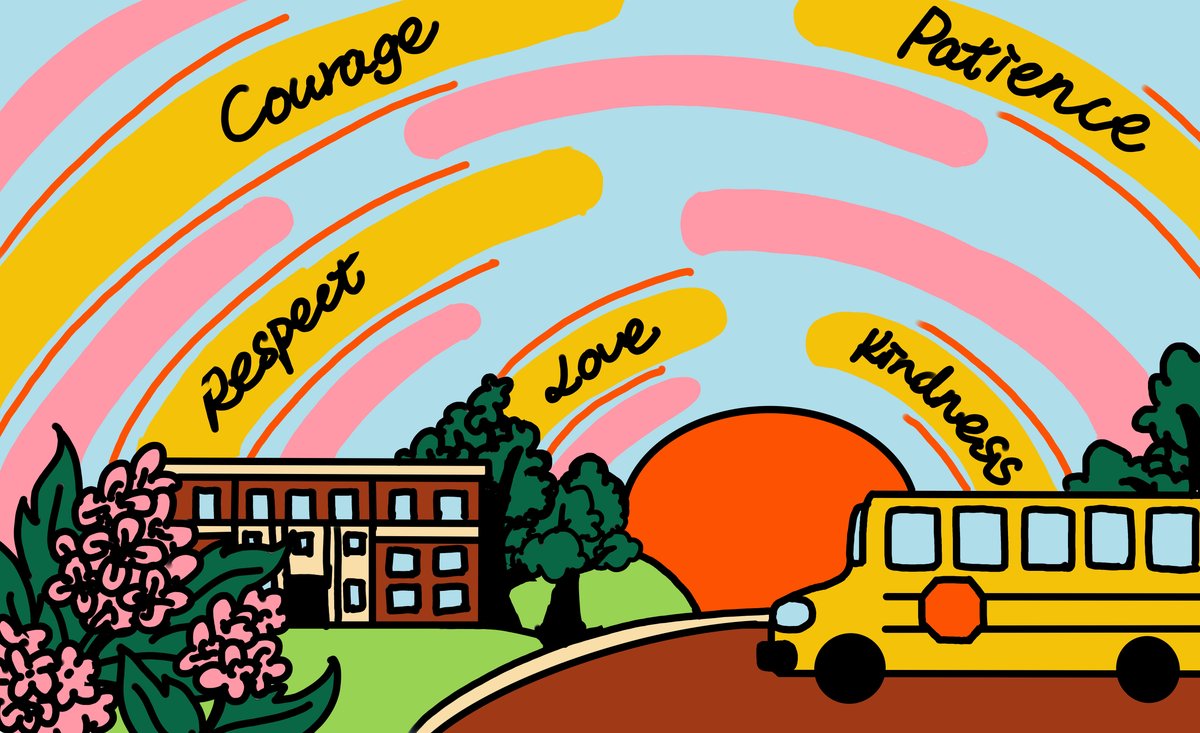
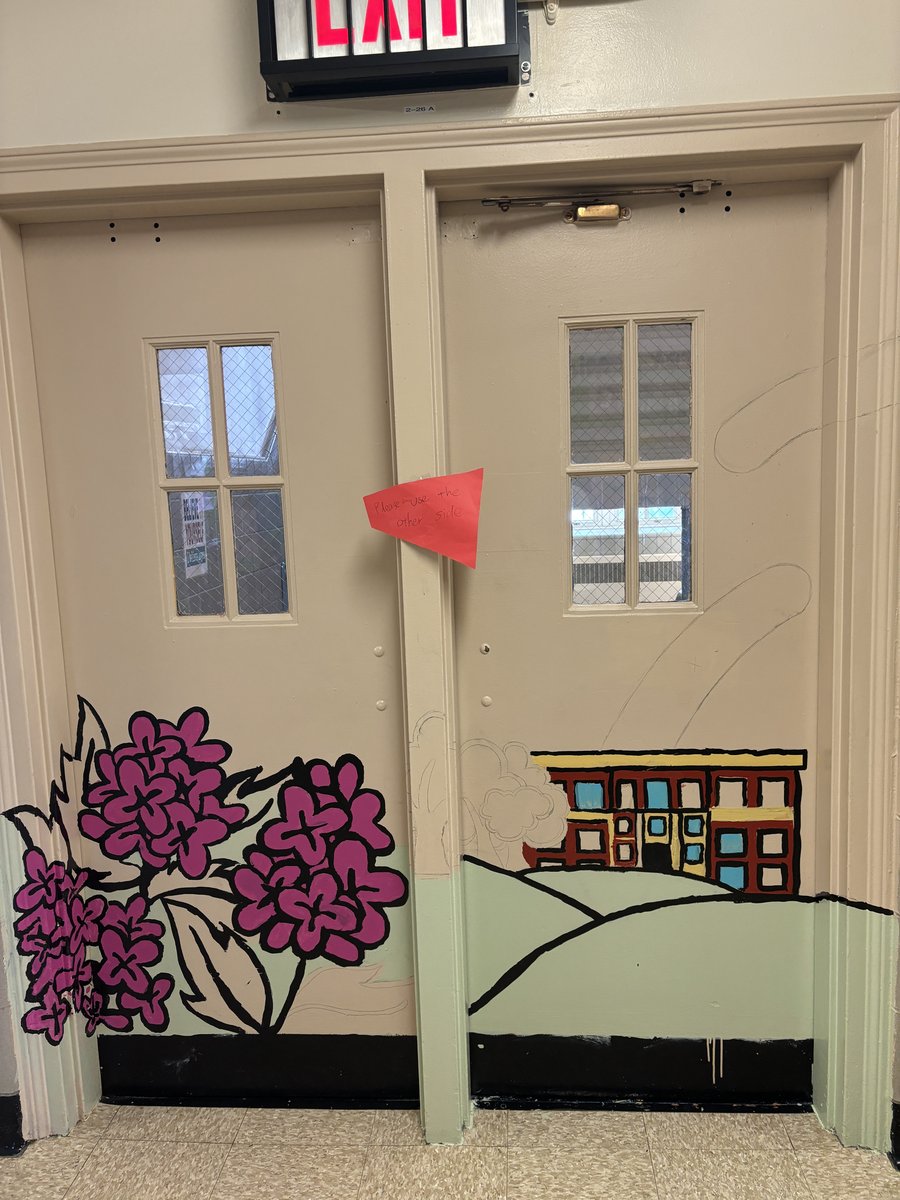
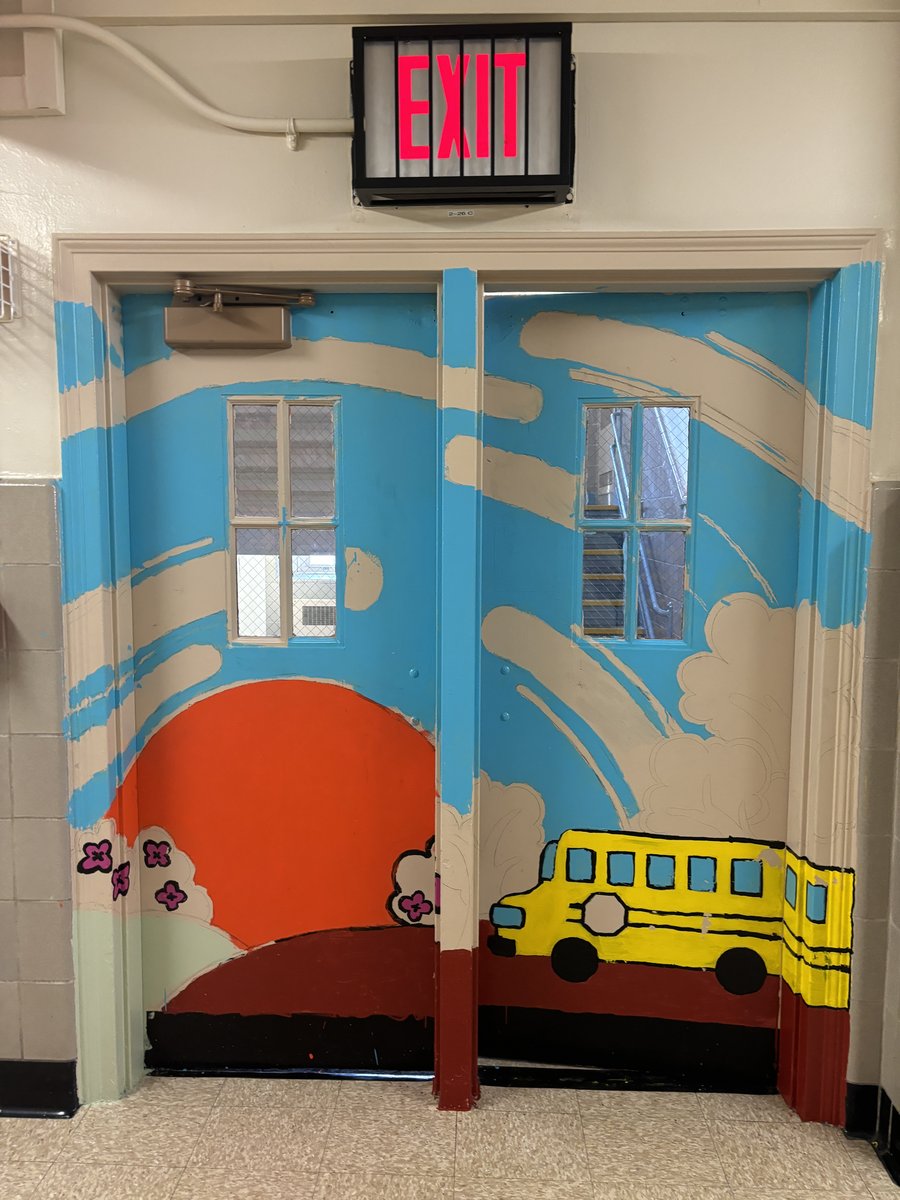
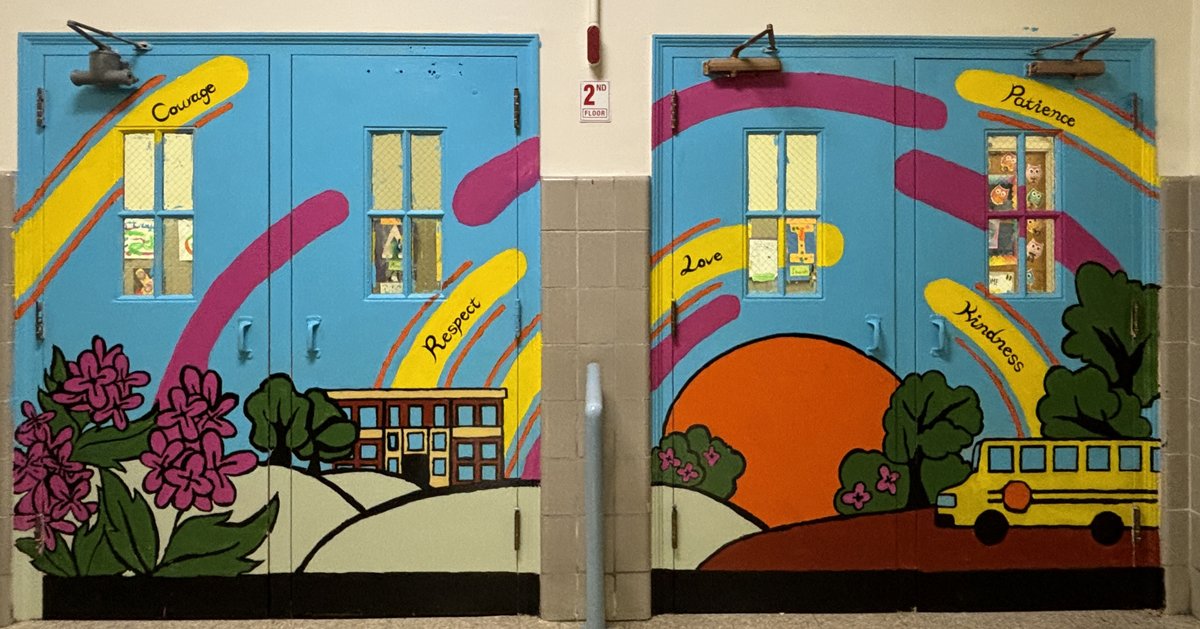
A collaborative mural project with 4th- and 5th-grade students through the Togetherhood after-school enrichment program. The project transformed four plain metal stairway doors into a continuous, full-colour mural celebrating school values—Courage, Respect, Love, Kindness, and Patience—through imagery grounded in the students' daily experience: their school building, cherry blossoms, a sunrise, and the school bus.

The Challenge

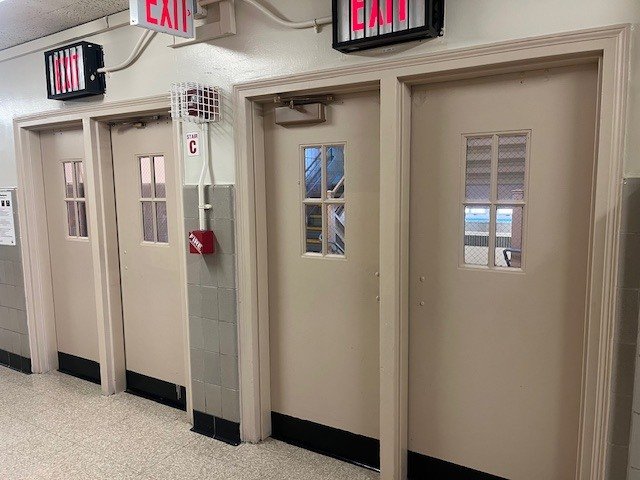
The school's second-floor stairwell had four plain metal doors (32″ × 80″ each) that felt institutional and disconnected from the vibrant community inside. The principal envisioned a sunrise with the school's five core values painted across the doors. The project needed to translate that vision into a cohesive design and execute it with two classes of students across eight 2-hour after-school sessions, with groups rotating in and out every 30 minutes. The design had to read as one continuous image across four separate doors and be durable enough for a high-traffic school environment—on metal surfaces that are especially prone to paint peeling.

My Role

  • Translated the principal's vision into a full mural concept, from hand-drawn sketch to final digital composition across four doors
  • Sourced and selected all professional-grade materials (Golden Fluid Acrylics, Liquitex, Minwax polycrylic varnish), navigating constraints like the school's request to skip primer due to odour concerns
  • Arrived early before sessions to prepare pencil sketches on the doors so students could focus on painting
  • Led painting workshops with rotating student groups across both grades, managing colour assignments and workflow
  • Created a detailed handoff plan enabling a substitute facilitator to lead a session independently when unavailable
  • Returned separately after all student sessions to complete final hand-lettering of the five core values, edge retouching, and protective varnishing

Context

  • Togetherhood after-school enrichment program at PS 115Q, New York
  • 4th-grade class (Tuesdays) painted the hallway-facing side; 5th-grade class (Thursdays) painted the staircase-facing side of the same four doors
  • Two sets of side-by-side double doors (32″ × 80″ each) on the second-floor staircase
  • Four 2-hour sessions per grade (2:30–4:30 PM), with 30-minute group rotations within each session

Research & Framework

  • Holding Environments: the school hallway provides a supportive yet challenging space where students feel safe to take creative risks under professional guidance
  • Situated Learning: creating a mural in the students' own school environment connects artistic practice to real-world community context
  • Peer Learning: small-group collaboration and peer feedback during painting sessions develop both artistic skills and social competencies
  • Multiple Means of Engagement: differentiated roles based on individual strengths ensure students with varying skill levels can all contribute meaningfully
  • Arts as a Distinctive Way of Thinking: the artistic process nurtures creativity, motivation, and the integration of cognitive, social, and emotional development

Design Process

The principal's brief called for a sunrise with the school's five core values across the doors. The final design reinterprets this as a single continuous scene spanning all four doors: the school building on the left, flowing colour bands carrying the value words across the centre, and a sunrise with school bus on the right. Cherry blossoms anchor the left edge, grounding the scene in the school's neighbourhood. The concept was developed through a hand-drawn sketch, refined into a digital composition, and then transferred onto the doors as a pencil outline before students began painting.

Digital sketch of the mural design

Digital sketch — final design mapped across four doors

Process

Plain stairway doors before the mural
Before — plain metal doors
Early stage with pencil sketch and first painted elements
Pencil sketch + first colours
Mid stage with sky blue base and major elements painted
Major areas painted by students
Completed mural with lettering and varnish
Final — lettering and varnish applied (4th grade side)
Completed mural - 5th grade side with all five values

Completed mural — 5th grade side (staircase-facing)

Teaching & Facilitation

  • Designed a group rotation system to solve the constraint of ~15 students per session who could not all paint simultaneously: three groups of 6–7, rotating in 30-minute shifts
  • Each 2-hour session followed a structured cycle: settle down (5 min), three group rotations (30 min each), clean up (15 min), dismissal and reflection (10 min)
  • Students were assigned differentiated roles based on their strengths—steady-hand students traced outlines, while others worked on large background areas—ensuring every participant could contribute meaningfully
  • Non-painting groups stayed in the classroom with a schoolteacher, working on homework or projects
  • A detailed written handoff plan—including group sequence, colour assignments, paint-mixing notes, and troubleshooting instructions—enabled a substitute to lead a session independently, which the substitute later confirmed worked smoothly

Design Rationale

  • Continuous composition across four doors creates visual unity in a fragmented architectural space
  • School-life imagery (building, bus, blossoms) grounds the mural in students' lived experience and neighbourhood identity
  • Core value words function as both decorative elements and daily visual reminders for the school community
  • Professional-grade materials (Golden Fluid Acrylics, Minwax polycrylic varnish) ensure durability on metal surfaces; primer was recommended but skipped at the school's request due to odour during school hours, requiring adapted surface preparation
  • Bold, warm colour palette (sky blue, pink, yellow, orange, green) ensures visibility and energy in a naturally dim stairwell

Impact & Insights

  • Transformed a utilitarian stairwell into a shared school landmark that every student in both grades passes through daily
  • Every student across two classes contributed directly to a permanent, public-facing artwork
  • The structured group rotation model kept all students engaged while maintaining painting quality across eight sessions
  • The handoff plan was validated in practice when a substitute successfully led a full session, confirming that the facilitation structure was clear enough to transfer
  • Navigating real-world constraints—primer restrictions, scheduling conflicts, material sourcing through Amazon—demonstrated adaptability in a school partnership context

The Glasses Hunt

  • Intergenerational
  • Interactive Book
  • Story Play
  • Dual-Audience Design
  • Paper Engineering
  • Play-Based Learning

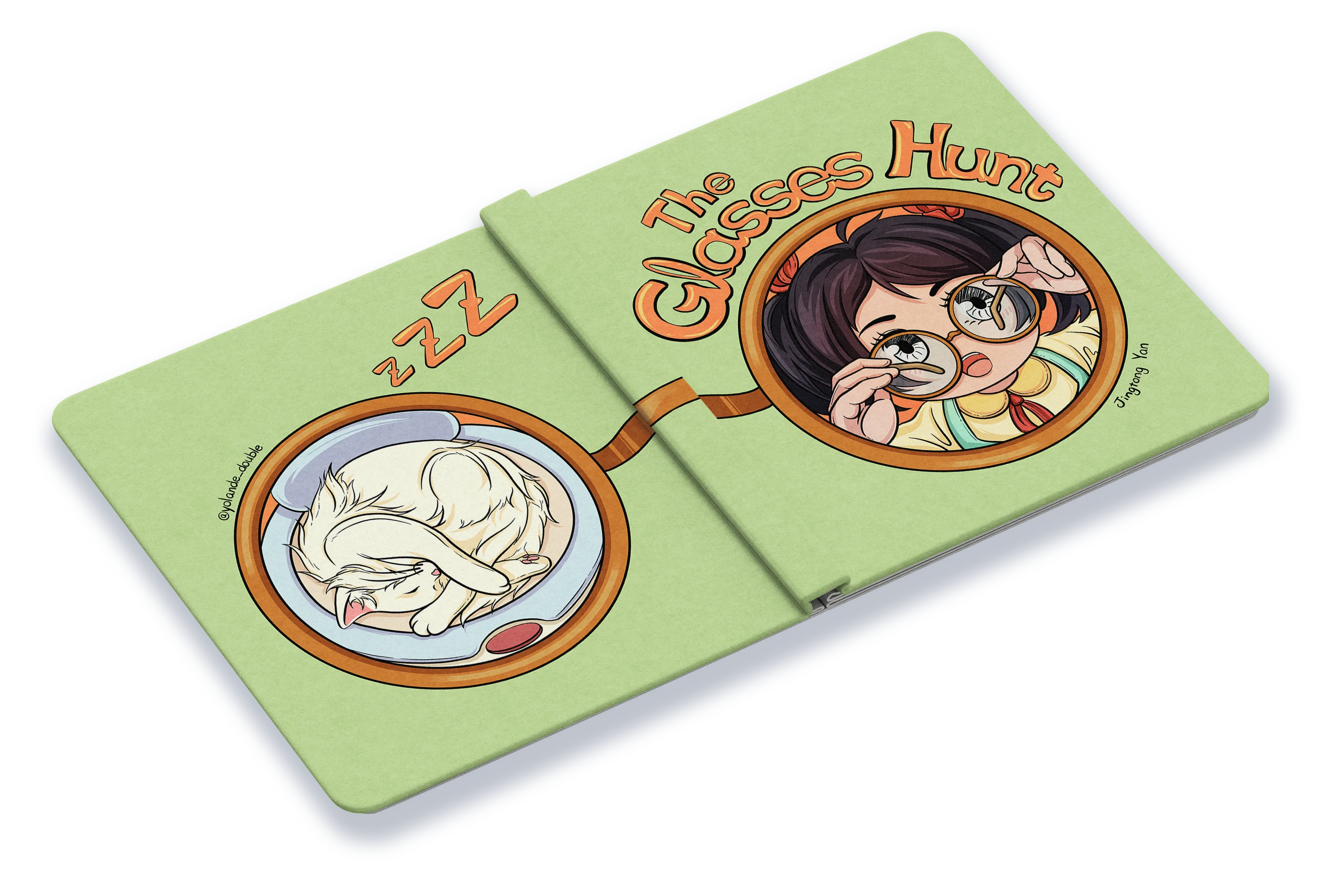
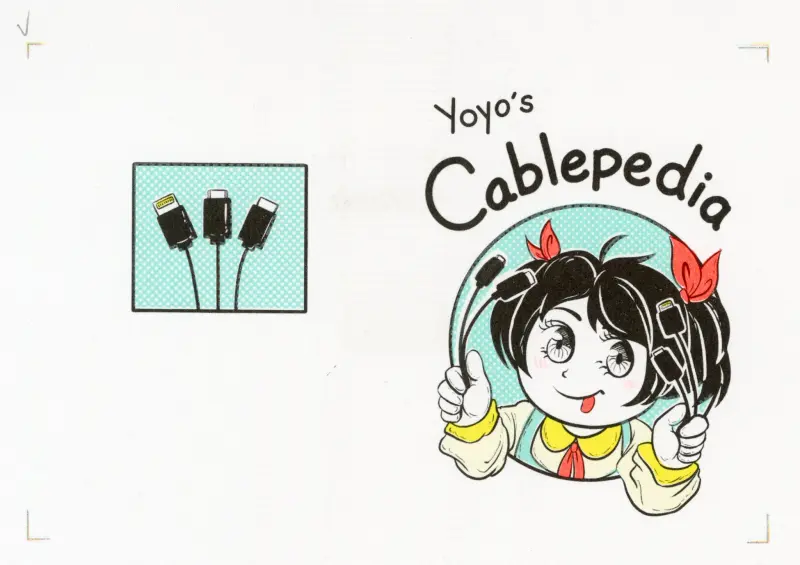
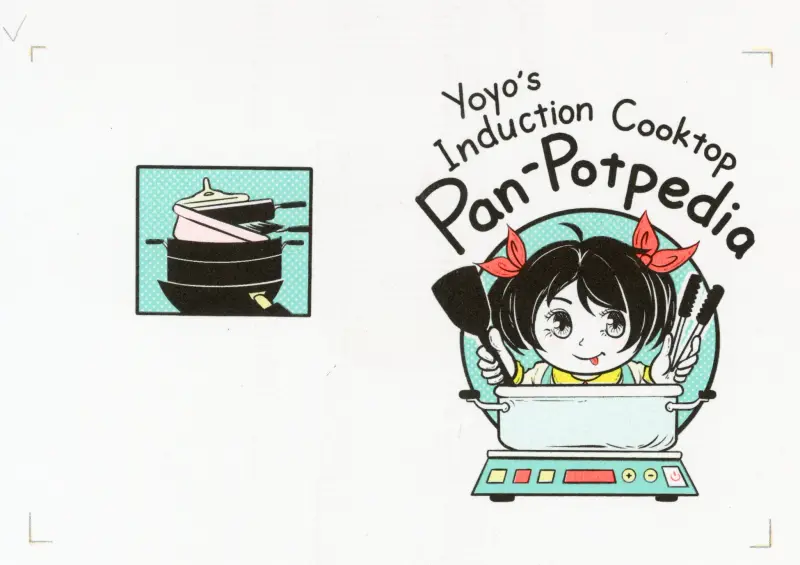
An interactive pop-up children’s book starring Yoyo and Grandma on a playful search for missing glasses. Through pop-up mechanisms, removable pieces, and hidden flaps, children explore each spread as a hands-on detective game. Two bonus Riso-printed zines—Cablepedia and Pan-Potpedia—tuck into the final spread, offering elderly readers clear visual guides to everyday technology. One book, two generations learning.

The Challenge

Most children’s pop-up books are designed for one audience: the child plays, the adult watches. The challenge here was to create a single book that gives both generations a meaningful learning experience. Children practise observation and problem-solving through interactive mechanisms, while grandparents gain practical knowledge through accompanying zines. The shared reading itself becomes a moment of intergenerational connection.

My Role

  • Sole creator from concept to finished product: story writing, thumbnail planning, pop-up mechanism design, digital illustration, Riso printing, and hand-bound hardcover bookbinding
  • Designed the full interactive architecture of the book—deciding which mechanisms serve each spread’s narrative purpose and how the two zines integrate physically into the final page
  • Researched and selected materials and production methods (Cricut cutting, Riso printing) to balance craft quality with reproducibility

Audience & Context

  • Primary readers: children with their grandparents, reading together
  • Target customers: middle-aged parents who value education but have limited time—looking for something that helps both their child and their parents
  • The book is handmade, but all pages and pieces exist as digital files, making it reproducible for wider distribution

Research & Framework

  • Learning through play: every pop-up mechanism serves the detective story task (finding the glasses), so children practise observation, reasoning, and motor skills while playing
  • Dual-audience design: the same product uses different media and information architecture to serve two age groups—interactive pop-ups for children, simplified visual guides for elderly readers
  • Intergenerational learning: the book creates a reason for grandparent and grandchild to sit together; learning happens naturally through their shared interaction rather than through explicit instruction

Learning Objectives

  • Children: develop observational skills, hands-on exploration, and reasoning through interactive pop-up mechanisms
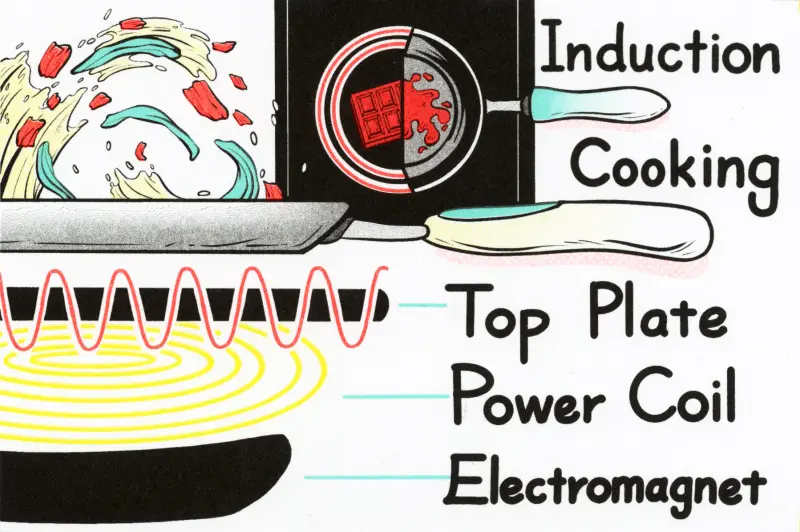
  • Grandparents: understand everyday modern technology (charging cable types, induction cooktop principles) through clear visual guides
  • Together: build intergenerational communication and mutual learning habits through shared reading

Design Rationale

Every interactive element in the book serves the “find the glasses” story task—pop-ups, flaps, and removable pieces are learning mechanisms, not decoration. Children search, lift, pull, and discover, building observation and reasoning skills through play.

  • Pop-up structures create spatial depth that invites physical interaction—children reach into the page rather than just looking at it
  • Removable pieces (like the oversized glasses on Spread 7, sized to a child’s face) extend play beyond the book itself
  • The final spread physically contains two pull-out zines, creating a natural transition from the children’s story to the grandparent’s learning material
  • Zines use large illustrations, minimal text, and high contrast—designed around elderly readers’ visual and cognitive needs
  • Riso printing keeps zine production low-cost, so grandparents can share copies within their own community

The Bonus Zines

Two Riso-printed zines (4 × 6 inches each) tuck into the book’s final spread. They transform everyday confusion into clear, visual knowledge—designed so elderly readers can learn independently and share with others.

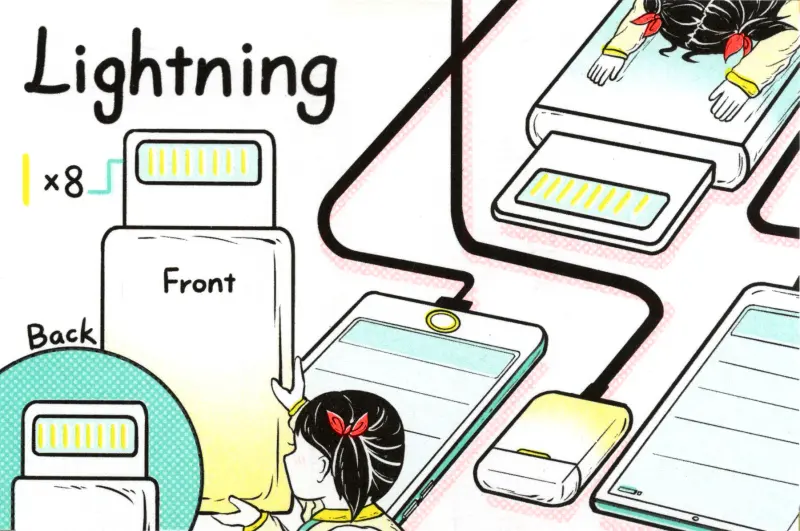
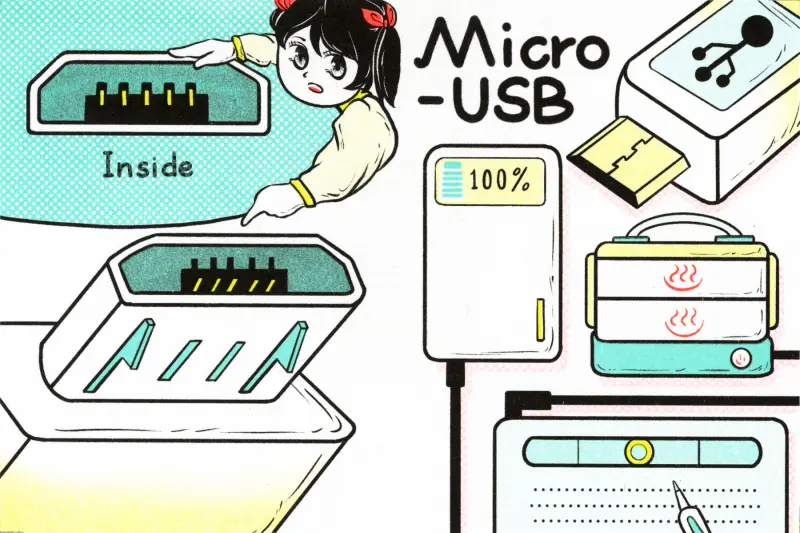
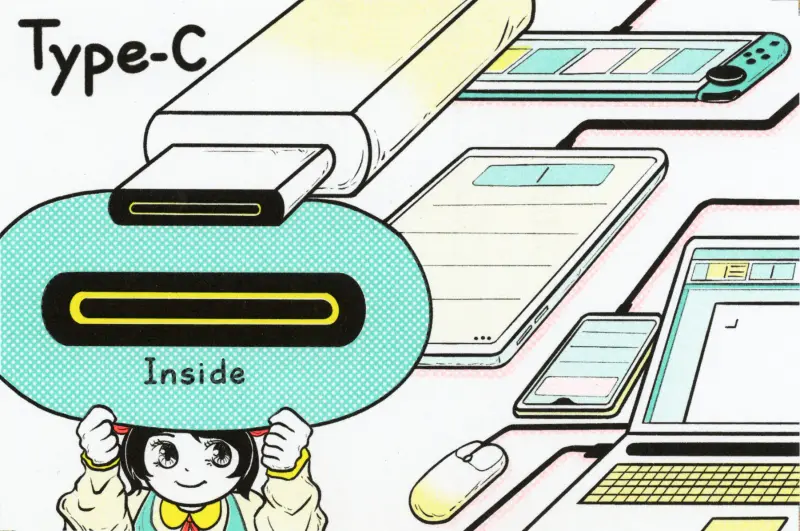
Cablepedia zine cover Cablepedia zine spread 1 Cablepedia zine spread 2 Cablepedia zine spread 3
Yoyo’s Cablepedia
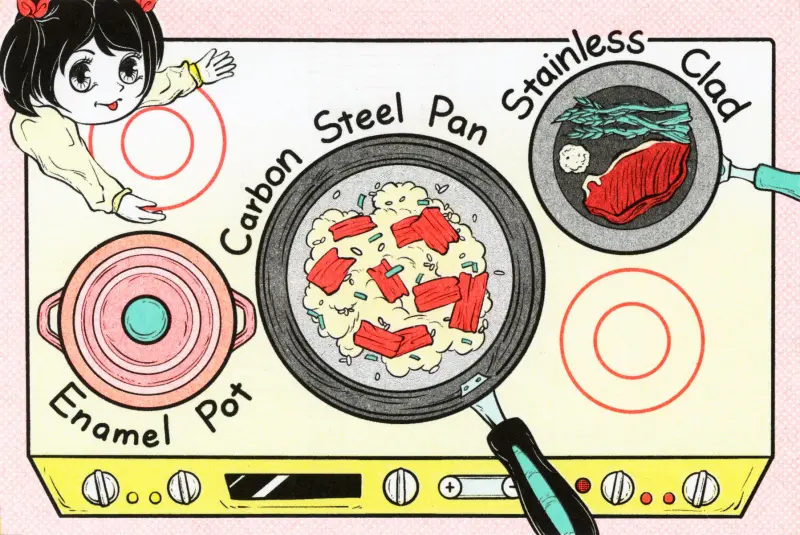
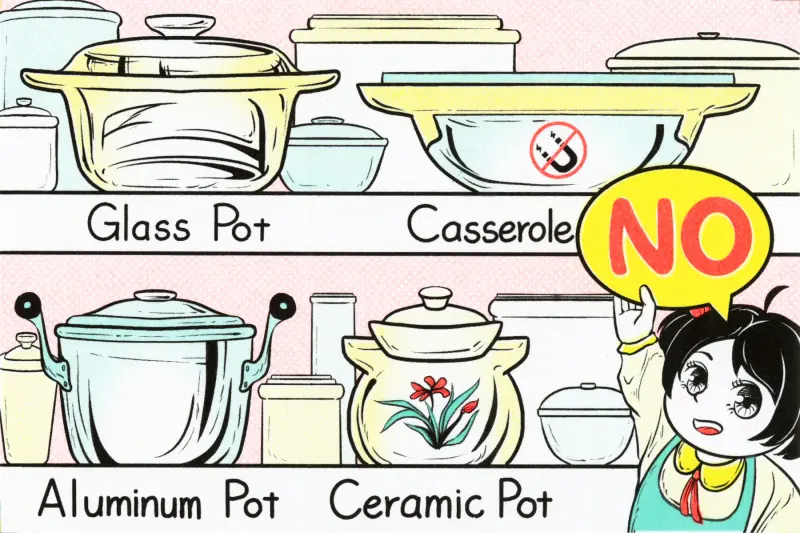
Pan-Potpedia zine cover Pan-Potpedia zine spread 1 Pan-Potpedia zine spread 2 Pan-Potpedia zine spread 3
Yoyo’s Pan-Potpedia
  • Cablepedia: a visual guide to differentiating charging cables (USB-C, Lightning, Micro-USB, etc.) with clear side-by-side comparisons
  • Pan-Potpedia: explains how induction cooktops work and which pots and pans are compatible, using simple diagrams and everyday language
  • Both zines fold out to a poster format on the reverse side, serving as a quick-reference that can be kept near the devices they explain

Impact & Insights

  • Demonstrated that a single product can meaningfully serve two generations with entirely different learning needs through thoughtful media differentiation
  • The zines proved practically useful: elderly readers could take them home and share copies within their own communities, extending the learning beyond the book
  • The strongest moments of intergenerational connection happened not through designed “teaching moments” but when the book simply gave grandparent and grandchild a reason to sit together—the learning followed naturally from the shared experience

Magic Dinner Table

  • Identity
  • Culturally Responsive
  • Workshop Design
  • Studio Critique
  • Hands-On
  • Competition Prep

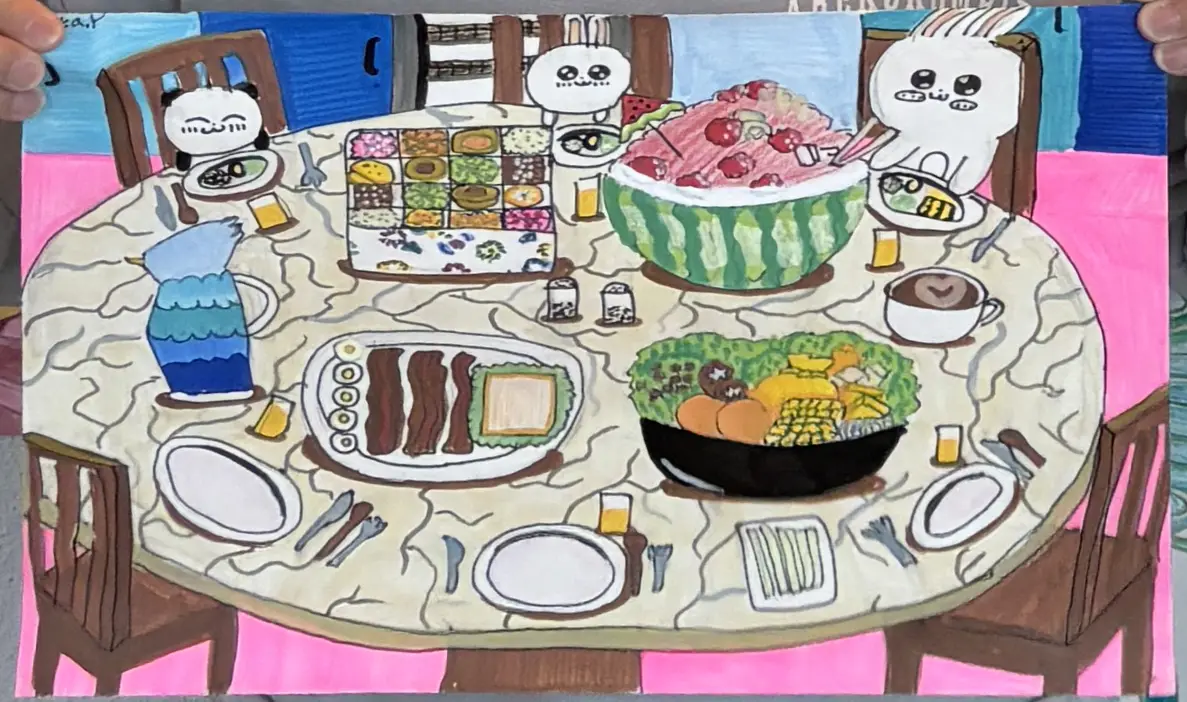
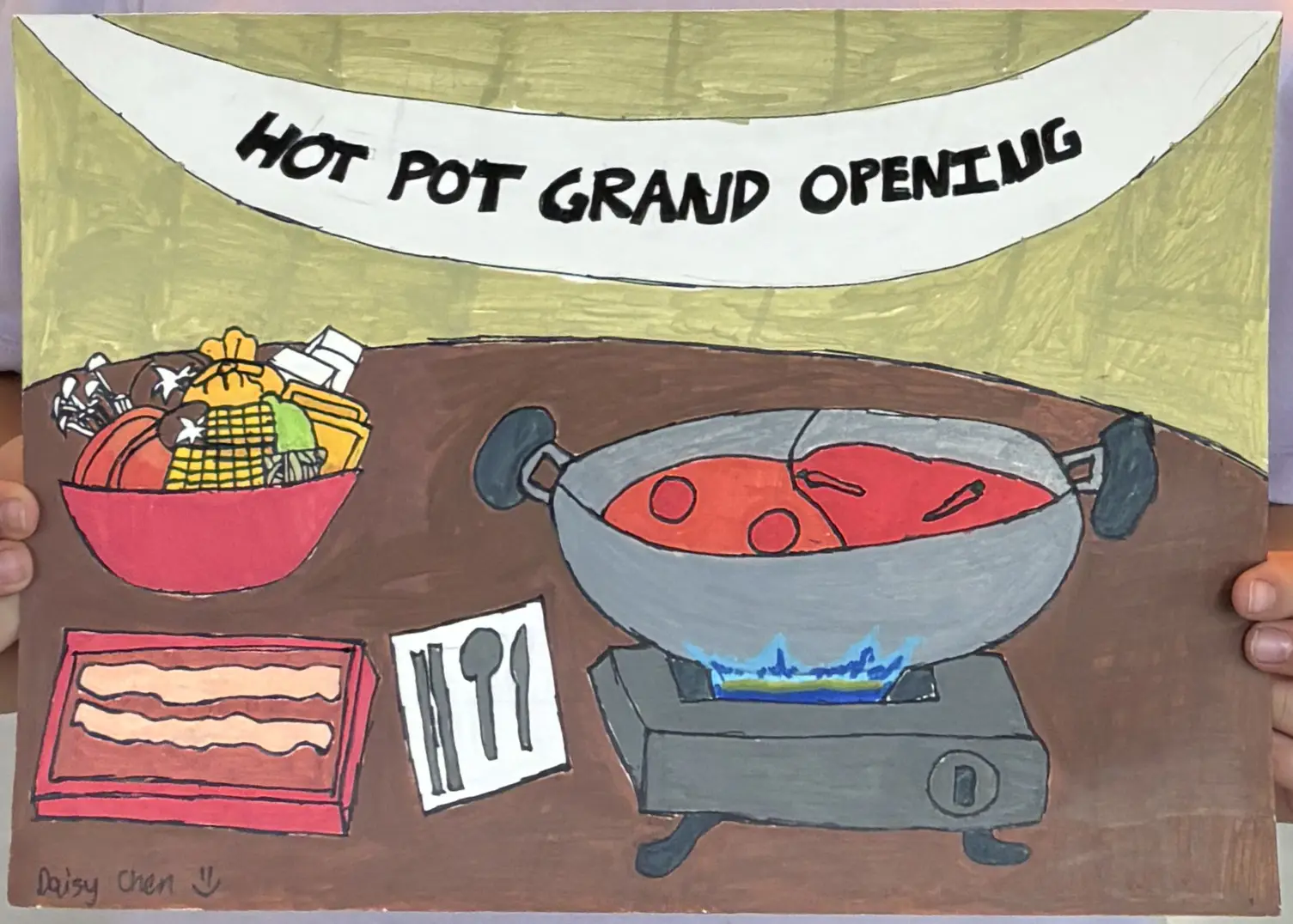
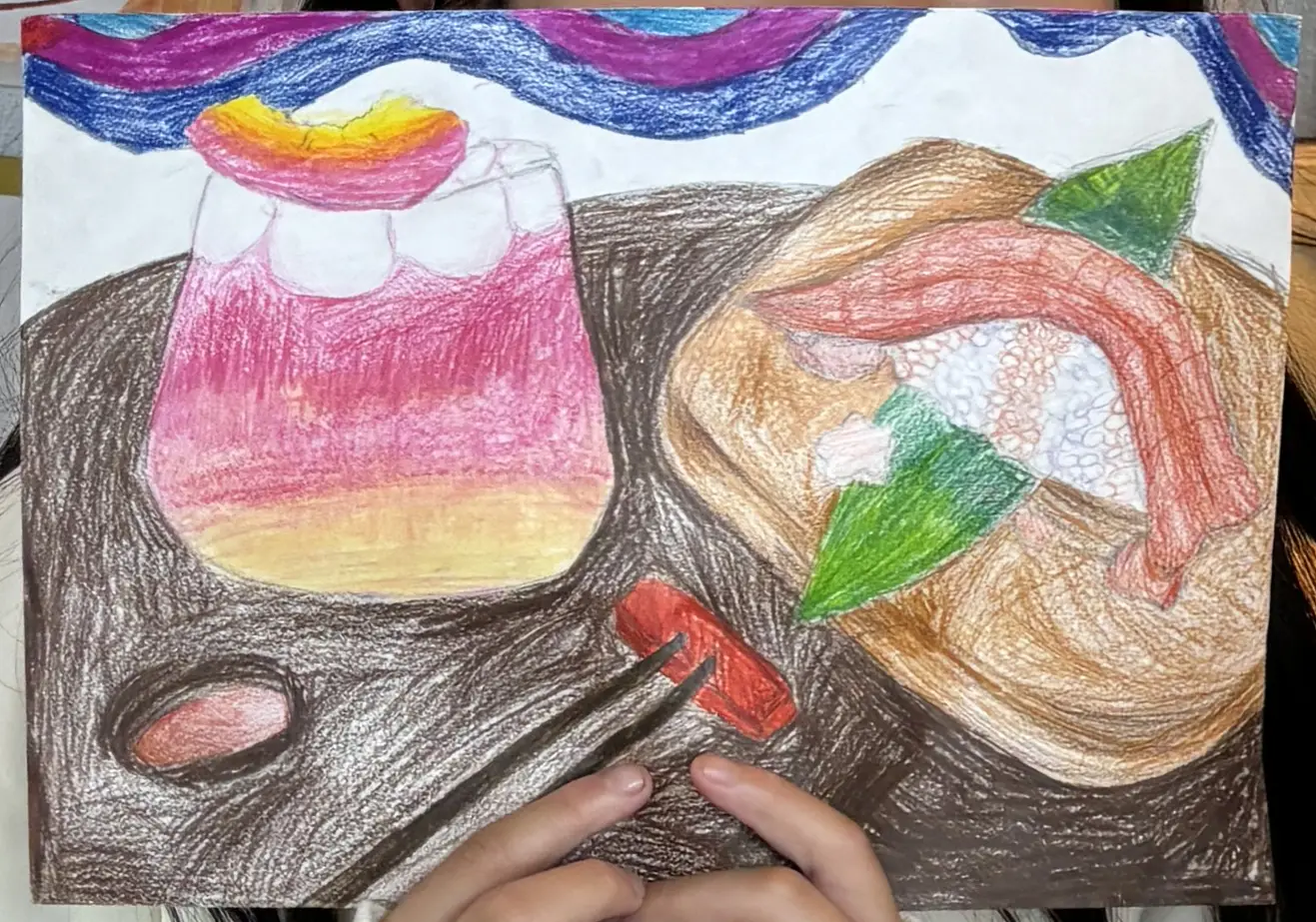
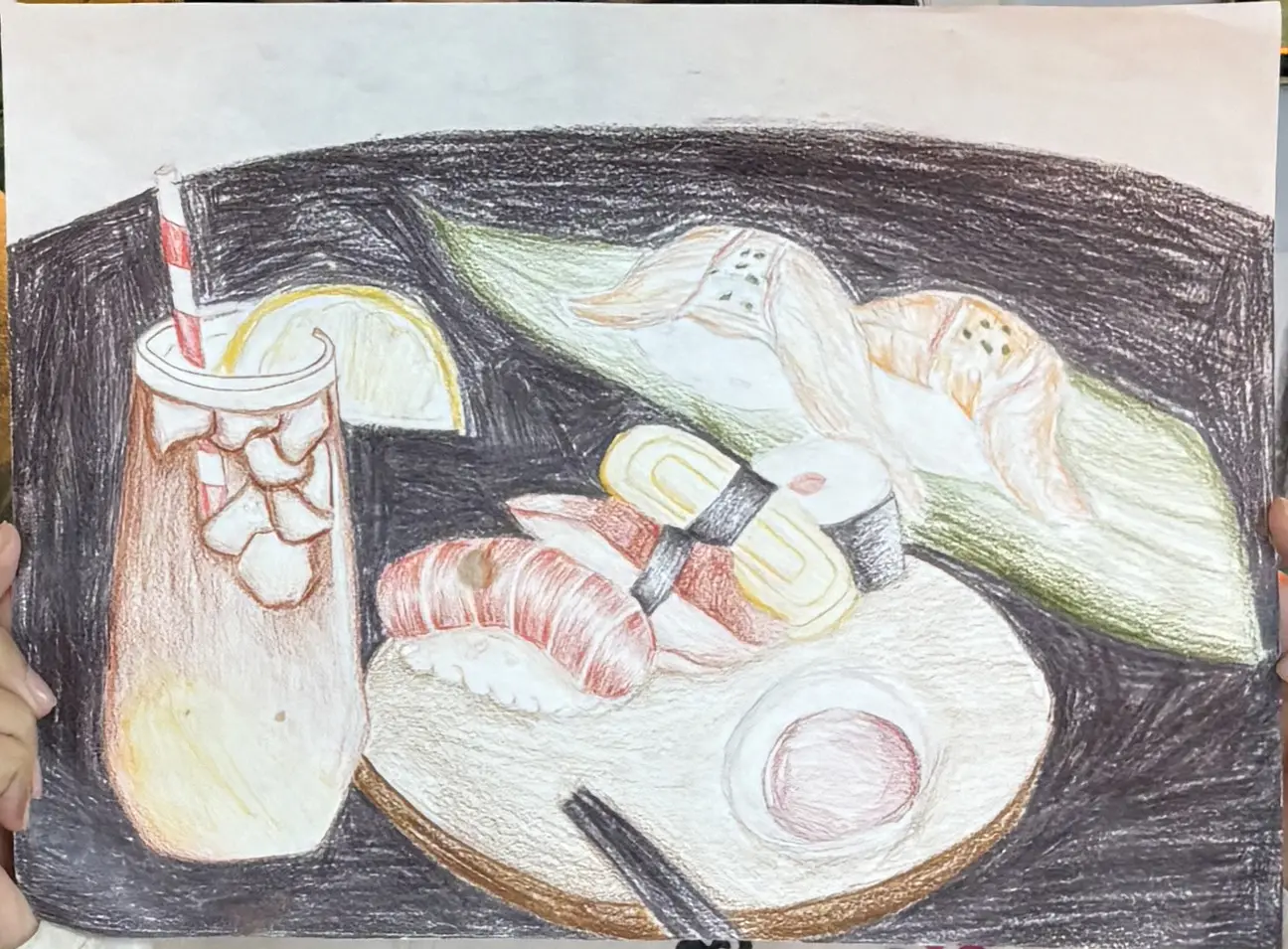
Magic Dinner Table was a 1.5-month competition-prep project for 12 students in grades 5 through 8 at a Chinese art studio in Queens, New York. The final works were created as drawing, painting, or mixed-media pieces on paper in response to a dinner-themed youth art competition.

What began as a technical drawing exercise gradually became a storytelling project. Instead of treating food only as still life, the learning experience invited students to connect dishes to family rituals, hometown traditions, and the emotional atmosphere of shared meals.

The Challenge

Students were already capable of making polished food drawings, but many of the early ideas felt disconnected from their own lives. The challenge was not simply to improve realism. It was to help students turn a competition prompt about dinner into artwork with personal meaning, while still meeting expectations for strong composition, appealing colour, and technical finish.

My Role

  • Served as instructor and project mentor throughout the full 1.5-month process, guiding concept development, drawing refinement, and final visual decisions
  • Structured the project sequence from brainstorming to reflection, helping students move from broad ideas to resolved final pieces
  • Led one-on-one critique and revision sessions tailored to each student’s concept, strengths, and technical needs
  • Balanced competition-prep expectations with a more student-centred approach that prioritised voice, memory, and cultural specificity

Context

  • Queens-based Chinese art studio in an after-school setting
  • 12 students across grades 5–8
  • Project duration: 1.5 months, with one 1.5-hour session per week
  • Final outcome: drawing, painting, or mixed-media work on paper for a youth art competition

Process

  • Brainstorming began with favourite dishes, family dinner memories, and the emotional tone of shared meals rather than with composition alone
  • Thumbnail sketches were used to test different story directions, table arrangements, and spatial relationships before committing to a final idea
  • Larger sketches translated those concepts into clearer scenes, allowing students to define figures, food, and environmental details
  • One-on-one critique and revision sessions focused on both craft and meaning: what needed to improve visually, and what details could make the work feel more specific and personal
  • Later sessions concentrated on refinement, overall adjustment, and final reflection so students could see how their ideas had developed from prompt to finished work

Design Rationale

  • Food was used as a culturally rich entry point because it naturally opens conversation about family habits, hometown traditions, celebration, and belonging
  • The project shifted emphasis from copying attractive dishes to constructing a meaningful dinner scene, so technique served narrative rather than replacing it
  • Multiple media approaches were left open to students, allowing different moods, textures, and storytelling strategies to emerge across the final works
  • Individual critique was essential: students did not need one model answer, but support in identifying what was uniquely theirs within the shared prompt
  • Reflection was built into the process so students could recognise that strong art comes not only from control, but from connecting visual decisions to lived experience

Student Works

A selection of student pieces from Magic Dinner Table, showing how students translated the shared dinner theme into distinct visual stories shaped by memory, family rituals, and personal atmosphere.

Student work from Magic Dinner Table project 1
Student work from Magic Dinner Table project 2
Student work from Magic Dinner Table project 3
Student work from Magic Dinner Table project 4

Impact & Insights

  • Students became more invested once the project moved beyond technical imitation and into memory, family stories, and personal association
  • The strongest final works were not simply the most realistic; they were the ones where composition, imagery, and cultural detail worked together to express a point of view
  • Food proved to be an especially effective bridge between formal art instruction and self-expression, because every student could connect it to real experience
  • In a competition-oriented studio context, critique can still be reframed as meaning-making rather than correction alone
  • The project reinforced my belief that students engage more deeply when art-making allows them to bring their own identities and histories into the work

Our Future NYC

  • Culturally Responsive
  • Youth Voice
  • Collaborative
  • Banner Design
  • Identity
  • Competition Prep

Our Future NYC was a collaborative banner project taught through a New York Edge-operated summer program at a public middle school in Jamaica, Queens. Rather than functioning as a one-off assignment, it was one part of a larger summer visual arts sequence, spanning multiple lessons focused on identity, monuments, neighborhoods, and New York iconography.

Within that broader curriculum, this banner unit asked students to imagine the future of New York City through culture, collaboration, and positive change. Many students initially saw art as disconnected from their interests, so I used culturally responsive brainstorming to connect the project to what already mattered to them: sports, local pride, family traditions, Caribbean identity, video games, and the visual energy of the city around them.

The Challenge

The project asked students to imagine a future New York City while meeting the real constraints of a contest banner: one shared message, one large collaborative composition, and clear inclusion of school information and New York Edge branding. The challenge was not just to generate ideas, but to help students in a Jamaica, Queens public-school summer program turn a broad civic theme into something personally meaningful, visually unified, and sustainable across several class sessions rather than a single workshop.

My Role

  • Served as visual art specialist and lead facilitator for the full multi-session banner unit
  • Adapted the New York Edge lesson plan and my own slides into site-specific prompts, vocabulary review, and visual scaffolds for students at a public middle school in Jamaica, Queens
  • Guided students from brainstorming and group draft-making into large-scale banner production, revision, and wrap-up
  • Helped translate students’ interests into one cohesive banner suitable for contest submission and school-site display

Audience & Context

  • New York Edge-operated summer program at a public middle school in Jamaica, Queens
  • Part of a larger summer visual arts curriculum rather than a standalone project
  • The banner unit ran across multiple lessons: brainstorming and draft in one week, final banner production across the following weeks, and a later wrap-up session
  • Organization-wide mandatory summer banner contest across all New York Edge sites
  • Theme: “Our Future NYC”
  • Final deliverable: one collaborative painted banner submitted to the Art Department for judging and public display

Research & Framework

  • Grounded in the New York Edge lesson plan, which framed the project around teamwork, cultural celebration, and positive civic imagination
  • My class slides reinforced key vocabulary such as culture and criteria, and used hook videos, inspiration prompts, and group-draft stages to structure the learning sequence
  • Culturally responsive teaching shaped the brainstorming process, so students could begin from their own neighborhoods, traditions, and interests rather than from generic symbols of diversity
  • Collaborative design thinking was central: students first generated ideas in smaller groups, then used critique and discussion to decide what should carry into the final shared banner
  • The contest rubric functioned as a real design brief, emphasizing imagination, celebration of culture, teamwork, and meaningful message

Learning Objectives

  • Envision a positive future for New York City by identifying aspects of NYC culture students wanted to celebrate and continue
  • Develop one clear collective message that could guide a large-scale collaborative artwork
  • Use art to connect personal identity, neighborhood experience, and public storytelling
  • Strengthen teamwork through shared decision-making, critique, and negotiated composition

Summer Sequence

The banner unit sat inside a larger summer curriculum, so students encountered it as part of an ongoing New York-centered progression rather than as an isolated contest assignment.

WeekUnitFocus
July 10–14My Culture + Draw and GuessIdentity-building, participation, and group energy at the start of the summer
July 10–28Our Future NYCMulti-session banner unit moving from brainstorming and draft-making into final banner production and wrap-up
July 24–28My NYC MonumentSculptural thinking and civic imagination through monument design
July 31–August 4Our Renewable Global NY NeighborhoodNeighborhood-centered making and environmental thinking
August 7–18NY Icon Printmaking + Face-In-Hole ReflectionNew York imagery, print processes, and reflective self-representation

Process

  • During July 10–14, students brainstormed and created group drafts using prompts from the slide deck such as “What are your hopes and dreams for the future of our wonderful city?” and questions about culture, positive change, and collaboration
  • In that early stage, students generated ideas on white copy paper with pencils and markers, testing how different cultural symbols, local references, and messages could work together
  • Rather than asking every student to draw the same thing, I encouraged them to develop individual imagery rooted in their own identity, culture, interests, and neighborhood references
  • During July 17–21, the project shifted into final banner production on canvas, using acrylic paint, color paper, glue, tape, brushes, palettes, and other classroom materials to scale those ideas up
  • The banner was revisited later in the summer for wrap-up and refinement, which made the project feel like an evolving culmination inside the broader program rather than an isolated assignment
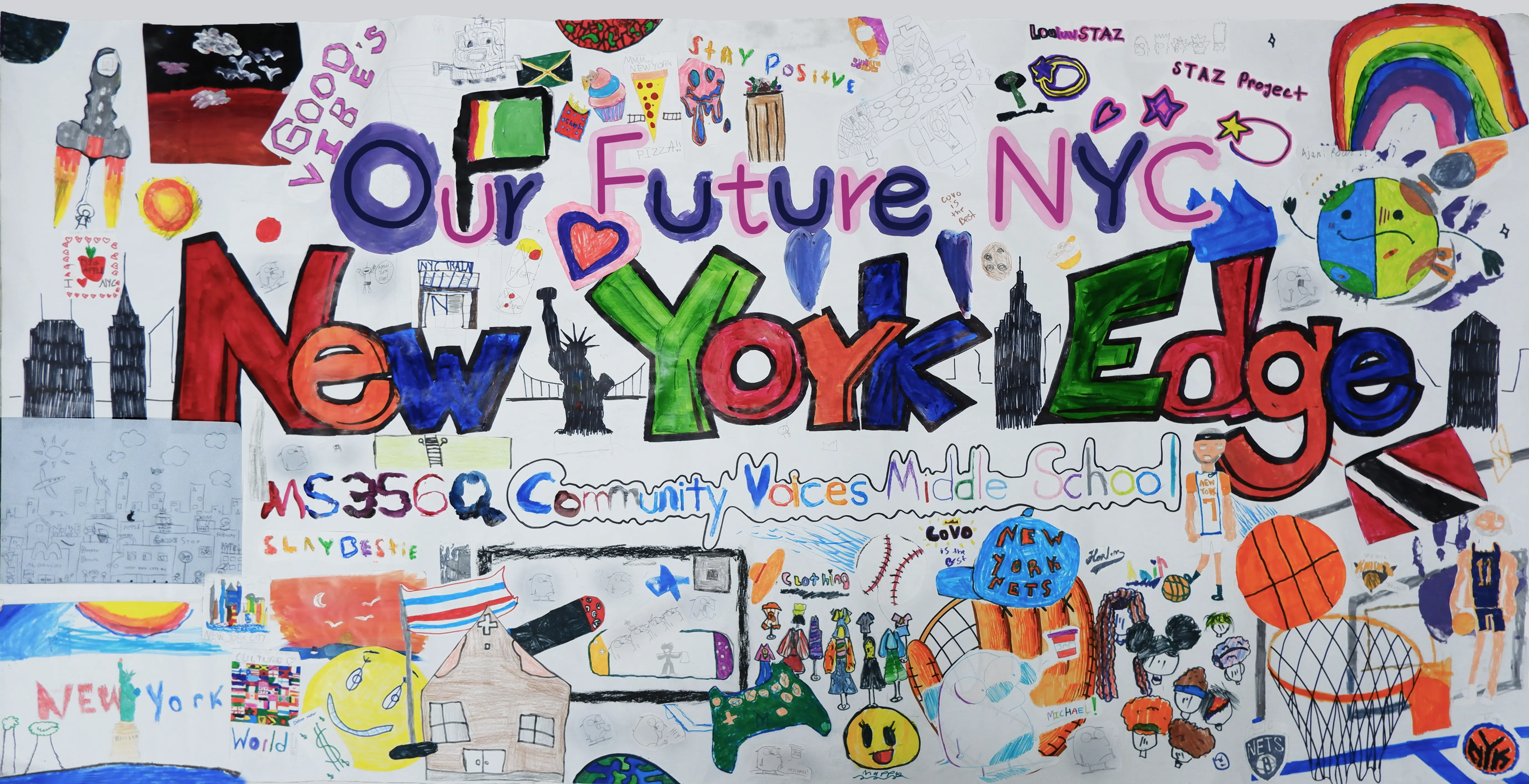
  • The final banner took shape as a collaborative collage: students’ individual drawings, symbols, and references were brought together into one shared composition that wove famous athletes, traditional clothing, Caribbean flags, video game references, and New York landmarks into a collective vision
  • The official brief shaped key decisions: the banner had to include school information and New York Edge branding, work within a 3-by-6-foot format, and respond to judging categories such as imagination, celebration of culture, teamwork, and meaningful message

Final Banner

The final outcome brought together individual drawings, symbols, and cultural references into one shared banner. Rather than smoothing out differences, the composition preserved distinct student contributions while turning them into a collective collage-like statement about identity, community, and the future of New York City.

Completed Our Future NYC banner created collaboratively by students
Final collaborative banner bringing together individual student contributions into one shared, collage-like composition.

Teaching Materials

The key teaching material in this unit was a custom slide deck that created a shared structure for discussion before students began designing. Rather than functioning as a step-by-step script, the slides helped stage the movement from vocabulary, to reflection, to visual ideation, to collaborative drafting.

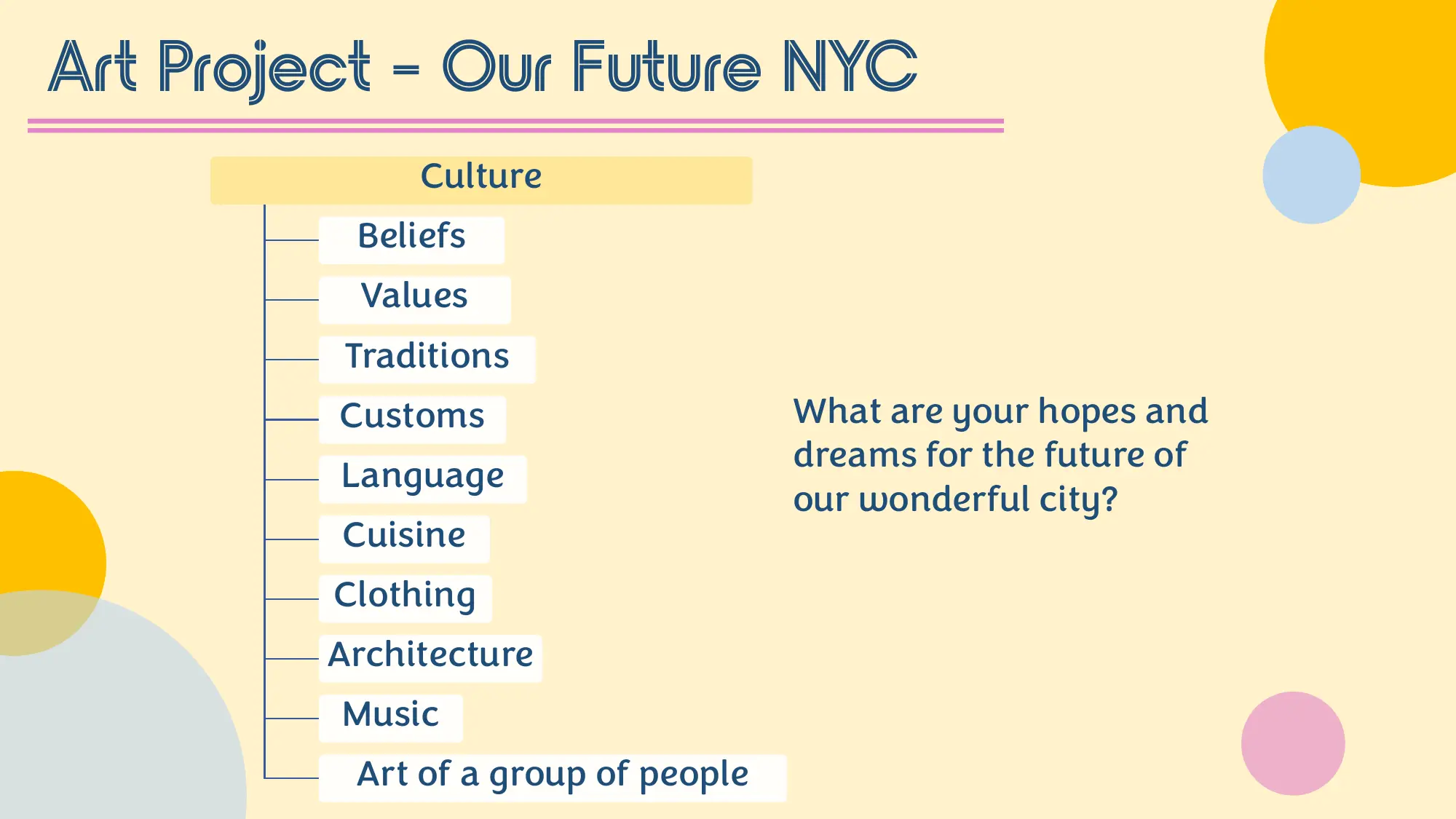
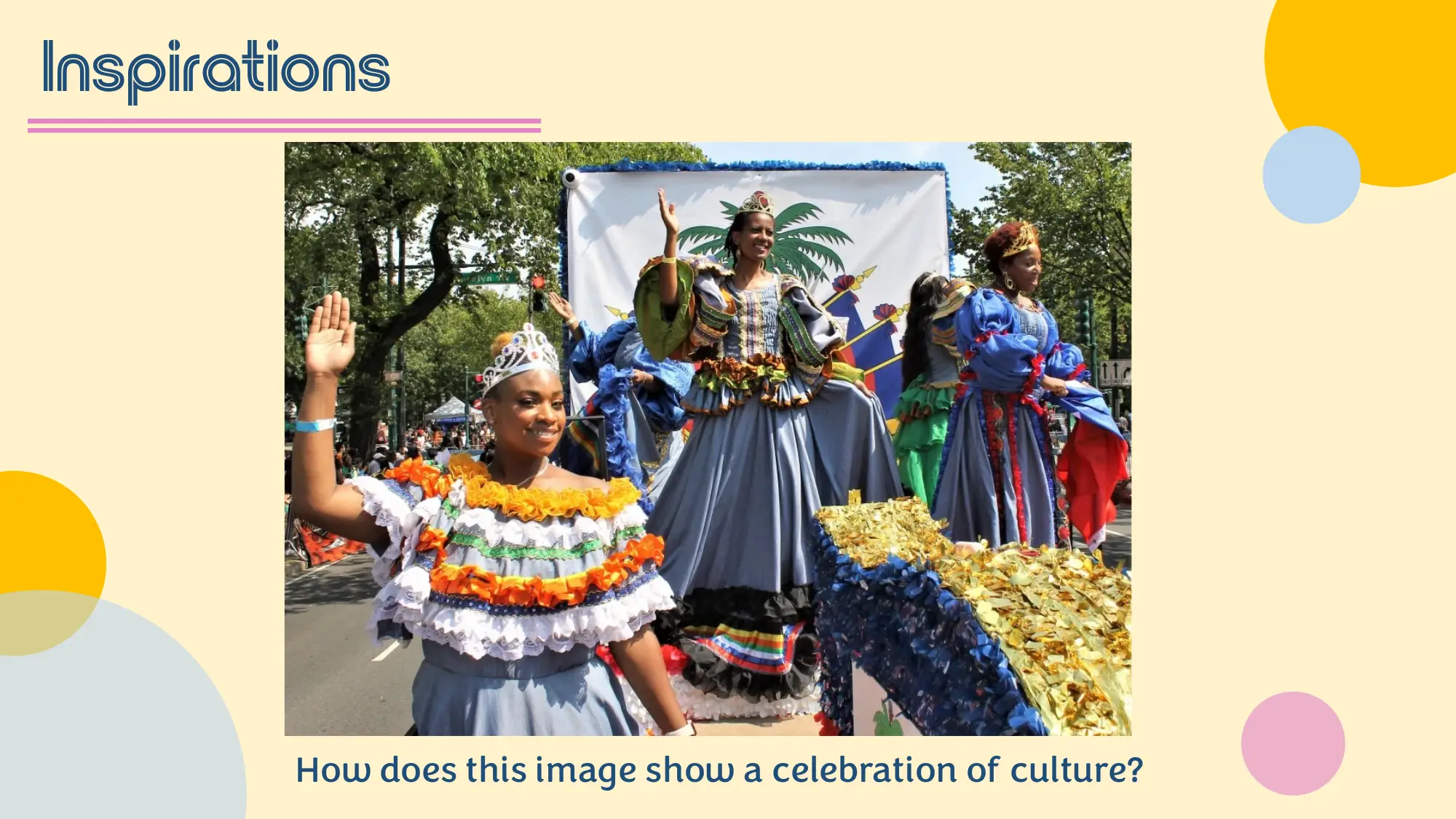
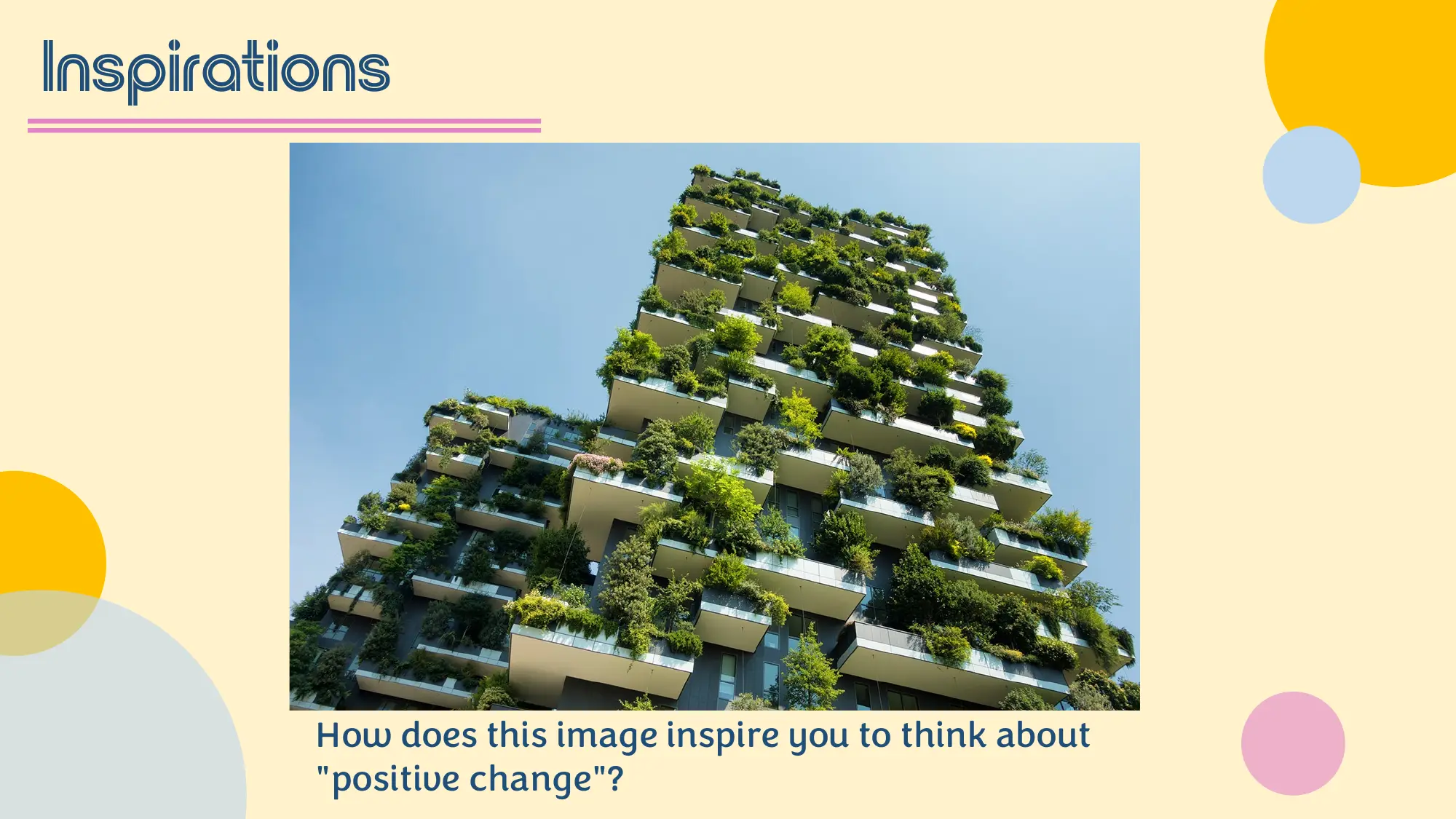
Our Future NYC teaching slide - future city prompt Our Future NYC teaching slide - culture celebration inspiration Our Future NYC teaching slide - positive change inspiration Our Future NYC teaching slide - culture brainstorming prompt

Big-picture prompt: inviting students to imagine hopes and dreams for the future of New York City

The slide sequence moved from broad visioning into more focused cultural reflection and then into collaborative planning. Instead of giving students a finished answer, the slides helped scaffold a progression: first imagining the future, then noticing examples of celebration and positive change, then connecting those ideas to their own lives, and finally translating them into a shared group draft.

Design Rationale

  • I intentionally moved away from generic representations of diversity and toward imagery students genuinely cared about, because relevance was the key to unlocking participation
  • Sports and pop culture became bridges into broader conversations about identity, representation, and belonging in New York City
  • Breaking the unit across several lessons allowed students to move from quick ideas to slower composition-building, which made collaboration more thoughtful and less rushed
  • The final form was intentionally collage-like: students could contribute individual imagery from their own identity and culture while still building toward a shared group artwork
  • The final composition emphasized flow across different contributions, so the banner would read as one message rather than a collection of disconnected parts
  • Using explicit vocabulary review and prompt-based slides gave students a clearer shared language for discussing culture, criteria, and positive change before they began making
  • By framing the banner as something that would be seen and judged beyond the classroom, students approached their visual decisions with stronger ownership and intention

Impact & Insights

  • Students became much more engaged once the prompt connected to their own hobbies, communities, and cultural references
  • The final banner showed that youth voice can be strongest when students are allowed to define what counts as meaningful culture for themselves
  • The collage structure made collaboration more flexible: students could preserve distinct visual voices while still contributing to a single shared banner
  • Collaborative school- and contest-facing work helped students practise not only image-making, but also negotiation, listening, and shared authorship
  • This project reinforced my belief that art teaching becomes most effective when identity, personal interest, and public communication are treated as inseparable

Choose Your Weekend

  • Family Learning
  • Decision Making
  • Prototype
  • Planning
  • Adaptive Thinking
  • Mobile Experience

Choose Your Weekend is a design-in-progress mobile learning experience for children ages 6 to 10 and their caregivers. Instead of treating weekend planning as something adults do for children, the project reframes it as a shared family activity where children can compare options, make choices within real constraints, and see their ideas shape what the family actually does.

The project began as a travel-planning game, but I shifted it toward everyday weekend planning because that context is more repeatable, more practical, and more grounded in ordinary family life. The current work includes the learning framework, a staged interaction flow, and an in-progress web prototype designed for phones and tablets.

The Challenge

Children are often included in family outings only after the plan has already been made. That limits their opportunities to practice decision-making, weigh trade-offs, or prepare meaningfully for shared experiences. The challenge of this project was to design a learning experience that gives children genuine planning agency without pretending that family choices happen without limits of time, budget, weather, or adult logistics.

My Role

  • Designed the overall learning experience and planning logic for the project
  • Mapped the user flow from caregiver setup through child choice, backup planning, preparation, family review, and reflection
  • Built an in-progress mobile-friendly web prototype to test how the stages could function as one connected system
  • Defined the project rationale, learning goals, and decision structures that guide the interface and interaction design

Audience & Context

  • Children ages 6 to 10 and their caregivers
  • Designed for everyday family weekend planning rather than one-time travel or special events
  • Structured as a repeatable home-based learning experience that families could return to across multiple weekends
  • Currently framed as a prototype and design study rather than a fully implemented or family-tested product

Research & Rationale

  • The project responds to a common family pattern in which adults make leisure decisions and children participate only after the plan is fixed
  • When children only encounter familiar options, their sense of what is possible narrows over time and weekend routines become repetitive
  • Lightweight preparation before an activity can deepen participation and help children build more specific memories of what they do
  • Planning together can function as a learning opportunity, not just a practical task, when children are invited to compare choices, consider constraints, and explain their reasoning

Learning Objectives

  • Shift children from passive participants to active co-planners of family leisure experiences
  • Develop structured decision-making by asking children to choose within constraints such as time, budget, and activity conditions
  • Build adaptive thinking by normalizing backup plans and contingency planning as part of everyday decision-making
  • Strengthen anticipatory thinking through preparation for the chosen activity
  • Encourage reflection on choices, trade-offs, and shared family outcomes after the plan is made

Learning Design Strategy

The project is designed around the idea that planning itself can be a learning experience. Instead of offering children unlimited free choice, the system makes choices meaningful by placing them inside family realities. The child is not simply picking a favorite activity; they are learning to compare options, notice constraints, anticipate changes, and justify selections that affect other people as well as themselves.

  • Constraint-based choice is used instead of open-ended browsing, so decisions feel realistic rather than purely wish-based
  • Trade-offs are made visible as part of the experience, helping children see how time and budget shape what a plan can include
  • Backup planning introduces flexibility and frames change as something to plan for rather than something that makes the original choice a failure
  • Preparation tasks extend the learning beyond selection by asking children to think ahead about what the activity will require
  • Reflection is included to help children consolidate why they chose a plan and how that decision connects to family context

Planned Experience Flow

The current design is organized into five connected stages. Together, they move from adult-set boundaries toward child choice, collaborative review, and reflection.

  • Stage 1: Set the Ground Rules. Caregivers define practical boundaries such as time, budget, and activity conditions so the child works within a realistic planning frame.
  • Stage 2: Pick Your Plan. The child explores activity options, compares them, and begins shaping a weekend plan within those constraints.
  • Stage 3: Choose Backups. The child selects backup activities in case the original plan changes because of weather, energy, or availability.
  • Stage 4: Pack Smart. The child identifies useful items for the planned activity and distinguishes them from distractors, turning preparation into part of the learning process.
  • Stage 5: Reflect. The child revisits what they chose, why they chose it, and how the plan fits the family context, making the experience more than a one-time decision chain.

Key Design Decisions

  • I shifted the project from travel planning to everyday weekend planning because repeated family routines offered a more practical and teachable context for decision-making
  • Caregiver-set constraints come first so the child’s planning work happens inside realistic family conditions rather than in an artificial space of unlimited options
  • Backup planning is built into the system to position flexibility as part of good planning, not as evidence that the first choice was wrong
  • Preparation is included because selecting an activity is only one part of participation; anticipating what the activity will require makes the eventual experience more meaningful
  • Reflection was added as a fifth stage so the experience does not end with selection, but instead encourages children to articulate reasoning, preferences, and family considerations
  • The overall system is designed as a repeatable routine that families could revisit across weekends, allowing planning skills to develop over time rather than through a single play session

Work in Progress

This project is still in development. The learning goals, five-stage structure, and core planning logic are defined, and an in-progress mobile web prototype is being used to think through interface flow and interaction states. At this stage, the project is best understood as a design study and prototype rather than a finished tool ready for public presentation.
  • The current prototype is helping me test how caregiver setup, child choice, backup logic, preparation, and reflection can work as one connected system
  • I am still refining how much information should persist across sessions, especially the difference between resuming a previous plan and starting a brand-new one
  • Navigation logic still needs clarification, including the distinction between returning home and resetting the plan
  • The reflection stage is conceptually important but still needs technical refinement, especially around saving and retaining reflection content reliably
  • A next question for testing is whether children interpret backup planning as flexible thinking rather than as a sign that their first plan was incorrect

Next Steps

  • Refine the prototype flow so the five stages feel intuitive and coherent across devices
  • Test the experience with real families to observe how children explain choices and respond to constraints
  • Clarify what should and should not be saved between planning sessions
  • Improve the reflection stage so it supports meaningful recall rather than becoming an optional afterthought
  • Evaluate whether the system genuinely increases children’s participation in family decision-making over repeated use
  • jingtongillustration@gmail.com
  • @yolande_double
  • LinkedIn

© 2026 Jingtong Yan. All rights reserved.